Choosing where to stay in the Dolomites is one of the most important decisions you’ll make when planning a trip to this region of northern Italy. I recommend staying in at least two of the following destinations: Val Gardena, Alta Badia, Cortina d’Ampezzo, San Martino di Castrozza, Alta Pusteria, and Val di Funes.
Avoid Bolzano. Although it’s the capital of South Tyrol, it’s not actually located in the Dolomites. If you base yourself there, you’ll spend a lot of time driving just to get to the trailheads.
The best way to plan a Dolomites trip is to choose two or three bases and split your time evenly between them. If you’re planning a shorter trip (3-4 nights), choose a single base. Because many Dolomites accommodations have a minimum stay requirement of 2-5 nights, it’ll be easier to book your trip if you stay in fewer accommodations for longer periods of time.
In this guide, I’ve shared our favorite destinations and accommodations across the Dolomites, shaped by over a decade of exploring the region. We’re also currently living in the Dolomites (see what we’ve been up to), so these recommendations reflect both long-term experience and up-to-date local insight.
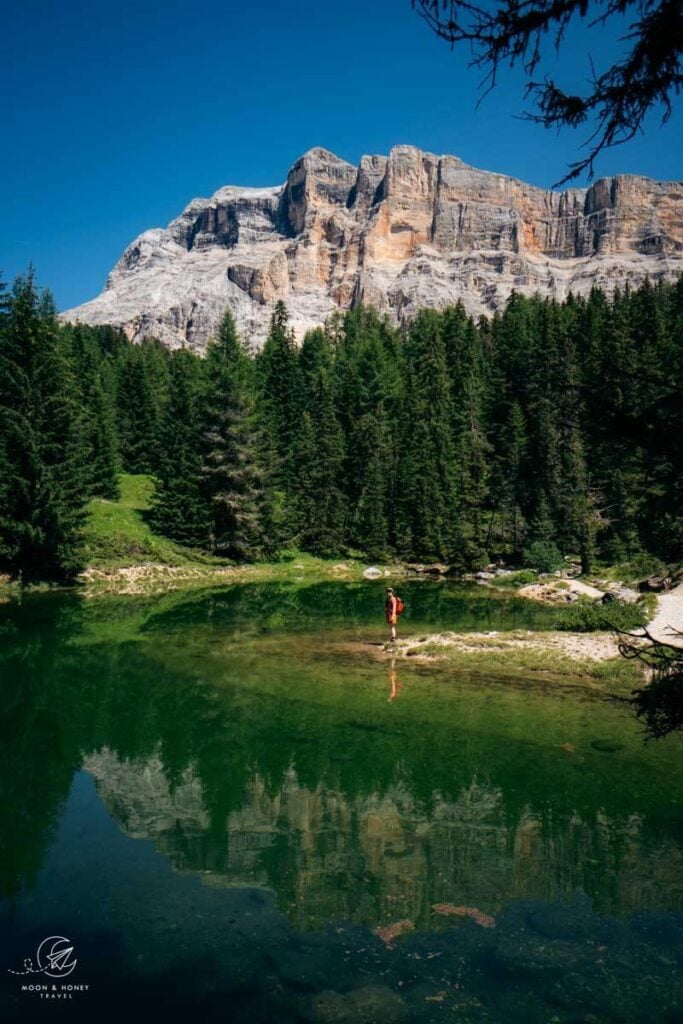
- Minimum Stay Requirement: Many accommodations have a minimum stay requirement of 2-7 nights in high season.
- Spa Facilities: In our experience, spa usage is always included in the room rate in hotels in South Tyrol. Contrarily, in Belluno and Trentino, wellness areas are often an extra charge.
- Sauna Etiquette: In South Tyrol, expect mixed, textile-free saunas. That means no bathing suit. You can read our guide to Austrian Thermen to acquaint yourself with sauna etiquette in the German-speaking world.
- Half Board: Most hotels offer half board (breakfast and dinner). Take advantage of this offering whenever you can.
- Tea Kettles and Coffee Makers: It is not a standard practice to provide tea kettles in rooms. English speakers tend to expect this, but it’s not usual in the Alps. Complimentary tea is often provided in spa areas.
- Dolomites Itineraries: 7 Day Road Trip, 5 Day Road Trip, and 10-14 Day Road Trip, and Munich to Dolomites Road Trip
Best Bases in the Dolomites: Quick Overview

1. Cortina d’Ampezzo is blessed with a dramatic setting in the Ampezzo Valley in Belluno. This is one of the most atmospheric towns in the Dolomites, thanks to its pedestrianized town center brimming with shops, bars, and restaurants. Most hikes around Cortina do not require cableways. However, a rental car is essential in getting around, especially if you’re visiting outside of high season. There is a bus transit system in place, but it’s not as robust, or as understandable as neighboring South Tyrol’s transit.
2. Val Gardena, the valley that stretches from Gardena Pass to Valle Isarco, is one of the best places to stay in the Dolomites if you’re traveling without a car, visiting during shoulder season, or if you’re seeking a single base (read my 1-Week Val Gardena Itinerary). Val Gardena’s summer season is very long, compared to other Dolomites regions. It can start as early as late May and end as late as early November. The main villages in Val Gardena are Ortisei, Santa Cristina, and Selva. The only downside is that it gets congested in high season. We only visit Val Gardena in late September, or October.
3. Alta Badia enjoys a central location, set between Puez-Odle Nature Park, Fanes-Sennes-Braies Nature Park, and Sella Group. This region also boasts an excellent transit system, high concentration of excellent family-run boutique and wellness hotels (e.g. Hotel Kolfuschgerhof) and gourmet mountain huts. If you’re looking for a luxurious holiday in the Dolomites, start your trip here. Alta Badia is also a favorite base among cyclists, mountain bikers, and families. The main villages are Corvara, Colfosco, San Cassiano, La Villa, and Badia. Budget options like farm stay apartments exist, but you’ll need a car to reach most of them.
4. Alta Pusteria is the Dolomites region surrounding Upper Puster Valley in South Tyrol. This is the gateway to the Northern Sexten Dolomites and the Northern Braies Dolomites. The main villages in Alta Pusteria are Dobbiaco/Toblach, San Candido/Innichen, and Sesto/Sexten. Home to many tourist hotspots, local authorities have introduced traffic regulations in summer to combat overtourism. Even so, there are many places to see that are far off the tourist trail like the Val Campo di Dentro and Vallon Popera.
5. San Martino di Castrozza is an alpine resort town in Primiero valley in Trentino. This is the best base for hiking in Pale di San Martino, the largest (and possibly the most magnificent) mountain group of the Dolomites. Stay here to experience the beauty of Val Venegia, Baita Segantini, and the moon-like Pale di San Martino plateau. San Martino di Castrozza offers more budget-friendly accommodations comparatively. The summer season is shorter here, ending in mid-September. Also, compared to the other Dolomites regions, the hotels are not as fine.
6. Val di Funes is the valley that runs from Valle Isarco to the base of the Odle/Geisler Group. This is one of the most picturesque and heavenly destinations in the Dolomites. Though most people only visit for a few hours, it’s totally worth staying several nights here to hike the Adolf Munkel Trail, Tullen Peak, Rifugio Genova, and Sass de Putia. I recommend staying in Santa Maddalena.
7. Alpe di Siusi is a vast plateau etched with mountain biking, e-biking and hiking trails, high above Val Gardena. Stay here between mid-June and mid-July, when wildflowers are blooming, for unhurried exploration and special occasions like honeymoons and anniversaries. This isn’t an ideal base for exploring beyond the plateau.
8. Val d’ Ega is the valley between the Catinaccio/Rosengarten Group and Latemar Massif. Stay here if you want to visit Lake Carezza and hike to the Vajolet Towers. The main village in Val d’Ega is Nova Levante.
1. Cortina d’ Ampezzo
Cortina d’Ampezzo is the best place to stay in the Dolomites if you want a vibrant town atmosphere along with access to some of the most celebrated Ampezzo Dolomites attractions.
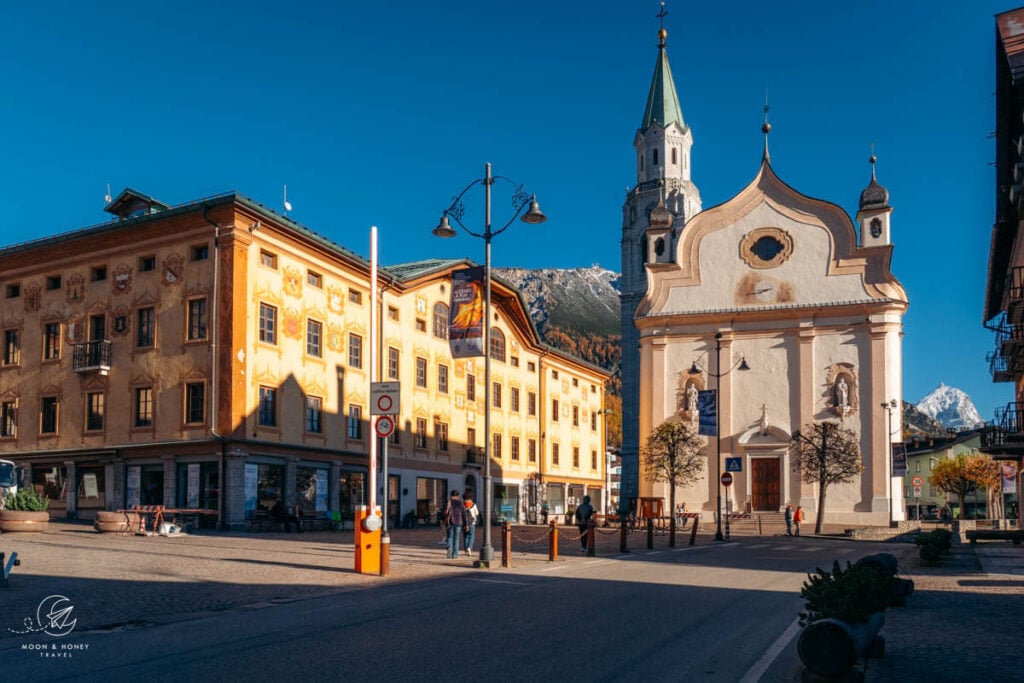
Cortina d’Ampezzo is a town, commune, and ski resort in the center of Ampezzo Valley in the Veneto Region.
Ringed by the rugged Tofane, Sorapiss, Cristallo, and Croda da Lago ranges, the Cortina basin enjoys one of the most striking alpine settings in the Dolomites. No two views of Cortina d’Ampezzo are ever quite the same; with every shift in perspective, an entirely new backdrop comes into view.
Cortina d’Ampezzo is often the first stop on a traveler’s Dolomites itinerary, because of its proximity to the Venice International Airport (2-hour drive). Most international travelers fly into Venice and head straight to Cortina, either via the Cortina Express shuttle or in a rental car.
Compared to other Dolomites towns, Cortina d’Ampezzo is significantly larger and offers more diversion in terms of shopping and dining. The town’s pedestrian zone, lined with restaurants, bars and cafés, is always a lively gathering place.
Why Stay in Cortina d’Ampezzo

Epic Hikes Without Cable Cars
Cortina d’Ampezzo’s advantageous location makes it easy to see and do a lot from a single base. What I particularly love is that the best trails do not require the use of any cableways. And, most trails do not intersect with the infrastructure of the Cortina ski resort.
- Tofana di Rozes circuit hike (my favorite hike in Cortina)
- Lago di Sorapis hike
- Croda da Lago circuit hike
- Mondeval Plateau hike
- Rifugio Nuvolau and Cinque Torri
- Setsas Circuit Trail
- Kaiserjägersteig to Lagazuoi
The southern Sesto/Sexten Dolomites are also within reach. From Cortina d’Ampezzo, it’s a 30-minute drive to Lago d’Antorno and a 40-minute drive to Rifugio Auronzo via the Tre Cime toll road (pre-booking required).
From these popular trailheads, you can embark on the Tre Cime di Lavaredo Circuit Trail, the Sentiero Bonacossa Trail, and visit the Cadini di Misurina viewpoint.
Iconic Mountain Lakes
Cortina d’Ampezzo is the best place to stay if you want to hike to the milky-turquoise Lago di Sorapis, the larch-fringed Lago Federa, and the Pelmo-mirroring Lago delle Baste.
Additionally, you can also easily visit the roadside lakes of Lago Misurina (22-minute drive), Lago d’Antorno (25-minute drive), Lago di Braies (50-minute drive), Lago di Dobbiaco (30-minute drive), and Lago di Landro (22-minute drive).
Learn More: Best Hikes around Cortina d’Ampezzo
Where to Stay in Cortina d’Ampezzo


Read Where to Stay in Cortina d’Ampezzo for a comprehensive guide to the best areas to stay in and around Cortina, with tips on finding affordable accommodation. Accommodations in Cortina d’Ampezzo are becoming increasingly expensive, so we recommend expanding your hotel search to the hamlet of Pocol (3-star Ciasa Vervei) and the town of San Vito di Cadore (3-star Fiori Dolomites Experience Hotel and 3-star Hotel Il Cardo).
If you want to be within walking distance to the town center, stay in Hotel Meuble Oasi (2-star guesthouse), Hotel Villa Alpina (3-star-superior), Ambra Cortina Luxury&Fashion Hotel (4-star hotel), or HOTEL de LEN (4-star hotel).
If you’re willing to drive, check out:
3-star Midrange | Baita Fraina is a charming B&B with six rooms with balconies, 3km from Cortina’s town center (5-minute drive). This guesthouse is also home to a Michelin recommended à la carte restaurant, which serves regional cuisine. Stay here for the mountain views, the affordability, and the food.
3-star Midrange | We had a wonderful experience staying in Fiori Dolomites Experience Hotel, a great-value hotel with an in-house pastry shop in the mountain village of San Vito di Cadore, 11-km south of Cortina d’Ampezzo. During breakfast, we savored their delicious homemade croissants, cakes, and Krapfen with various fillings. And in the afternoons, we enjoyed a complimentary snack featuring more of the hotel pâtisserie’s cakes and pastries.
4-star Luxury | Dolomiti Lodge Alverà is a splurge-worthy hotel in Cortina d’Ampezzo, featuring an on-site spa and pool, on-site restaurant, and plush suites. Guests rave about the hotel’s mountain views, breakfast, wellness facilities, and design.

HOTEL de LEN
4 star hotel in Cortina d’Ampezzo
HOTEL de LEN is an impeccably-run, 4-star luxury hotel in Cortina’s town center, just steps away from the pedestrian zone.
It exudes luxury in the shape of classy interiors, a rooftop spa, wellness-promoting rooms, a clandestine cocktail bar, and a restaurant featuring riffs on local cuisine.
Each room features air-conditioning, sound insulation, energy-enhancing bed panels, and a filtration system, installed to promote well-being by removing electromagnetic pollution.
Read our HOTEL de LEN review.
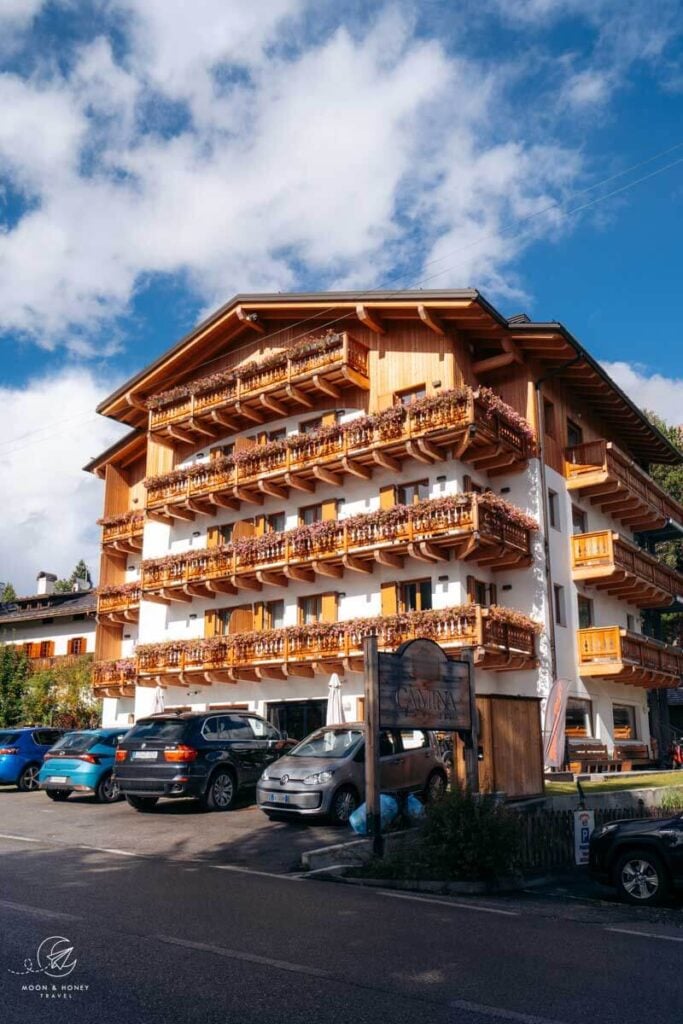
Camina Suite & Spa
4 star hotel in Cortina d’Ampezzo
Camina Suite & Spa is a small boutique hotel with 12 rooms. This lovely hotel oozes charm while capturing a comfortable chalet-modern aesthetic.
Suites are bright, cozy, and functional with oak floors, fir wardrobes, and modern bathrooms. All room are sound-insulated and have air-conditioning.
Located on the top floor, the adults-only (18+) hotel spa is a smart space with three saunas (hay, steam, and Finnish), a relaxation area, multi-sensory showers, and a tea bar. Use of the spa is complimentary (4 -8 pm daily).
We loved the delicious breakfast, in-room Nespresso machine and kettle, free on-site parking, and an on-site restaurant.
Read our Camina Suite & Spa Review.
2. Val Gardena
Val Gardena is a perfect base in the Dolomites for hiking and for those traveling without a car.

Val Gardena (Gröden in German) is a valley and ski resort in South Tyrol, stretching from Valle Isarco (Eisacktal) to Passo Gardena and Sella Pass.
Why Stay in Val Gardena
Free Public Transit Card
Overnight guests in Val Gardena receive a free public transit card for the duration of their stay, which makes getting to various trailheads and other villages hassle-free.
You don’t have to worry about finding and paying for parking. Also, you can use this free transit card to get to other destinations in South Tyrol, like Alta Badia and Bolzano/Bozen.
Accessible Day Hikes
There are a number of cable cars that connect the valley to various summits and plateaus in the Val Gardena Dolomites: Seceda and Resciesa Plateau in Puez-Odle Nature Park, the Alpe di Siusi/Seiser Alpine Pasture, and the Sassolungo/Langkofel Group.
That means you can spend days exploring the most beautiful mountains surrounding Val Gardena, without having to suffer through long, grueling ascents. Val Gardena’s accessibility makes it a top destination for a hiking holiday in the Dolomites.
Here are several Val Gardena hikes with cableway ascents:
- Seceda to Regensburger Hütte Circuit
- Resciesa to Malga Brogles and Seceda
- Col dala Pieres Summit
- Piz Duleda
- Alpe di Siusi Meadows Circuit
- Alpe di Siusi to Monte Pana
Here are a few Val Gardena via ferrata routes with cableway ascents:
Learn More: Best Day Hikes in Val Gardena
Long Summer Season
In most Dolomites holiday regions, the summer season ends by mid-late September. That means most restaurants, cableways, and hotels shut down and don’t re-open until the beginning of the winter season.
Luckily, Val Gardena has a very long summer season. Many hotels, cableways, and alpine pasture huts stay open until late October, or even early November, thus stretching out the “summer season” considerably. Read about hiking in Val Gardena in autumn in the these posts: Hiking in the Dolomites in September and Hiking in the Dolomites in October.
Val Gardena Towns
There are three villages in Val Gardena/Grödnertal:
- Ortisei (St. Ulrich in German, Urtijëi in Ladin)
- Santa Cristina (Sankt Christina in Gröden in German, Santa Cristina Gherdëina in Ladin)
- Selva di Val Gardena (Wolkenstein in German, Sëlva in Ladin)
We’ve stayed in all three villages multiple times. Each has a unique advantage. Below, we’ve outlined the differences between each village, so you can decide where in Val Gardena you want to stay.
For an in-depth look at where to stay in Val Gardena, read our Val Gardena Hotel Guide.
Ortisei

Ortisei is one of the most popular bases in the Dolomites, and for good reason. Its cableway connections to Seceda, Resciesa, and Alpe di Siusi make it incredibly easy to get straight into the mountains. Without having to venture outside of town, you have access to many different hiking trails:
- Via Ferrata Sass Rigais (Intermediate Grade B/C)
- Resciesa to Malga Brogles and Seceda (Difficult)
- Seceda to Regensburger Hütte (Easy – Moderate)
- Alpe di Siusi Meadows Circuit Trail (Easy – Moderate)
- Alpe di Siusi to Monte Pana and Santa Cristina (Easy)
It’s also one of the most convenient places to stay in the Dolomites without a car, thanks to its three cable cars, direct bus link from Bolzano, and easy-to-navigate transit system.
Of all the villages in Val Gardena, Ortisei also has the most lively town center, with plenty of restaurants, cafés, and wine bars. If you like having different restaurant options within walking distance, stay in Ortisei.
That popularity, though, comes with a trade-off. In peak season, it can feel crowded, indeed overwhelmingly so. Overtourism isn’t an issue across the entire Dolomites, though certain places like Ortisei draw heavier crowds.
If you’re traveling with a car, you have more flexibility, and I’d suggest looking at the hillside accommodations overlooking Ortisei like 4-star Alpenhotel Rainell and 3-star Garni Hotel August, which are both a short walk to the Ortisei-Alpe di Siusi gondola and a 10-minute walk to the town center. Mountainside Hotel Digon, Hotel Niblea, or La Cort My Dollhouse – Adults Only are all great options, but no longer walking distance to the town center.
In the town center, you’ll find Adler Spa Resort Dolomiti (5-star hotel) and its sister property ADLER Spa Resort BALANCE (ages 14+), Hotel Angelo Engel (4-star hotel).
These accommodations are all within walking distance to the town center: Casa al Sole (B&B), Cësa Gredine (apartments), Boutique Hotel Planlim (3-star hotel), Pra Palmer The Green B&B (3-star hotel), Hotel COSMEA Dolomites (4-star hotel), Gardena Grödnerhof Hotel & Spa (5-star hotel), B&B Lavi Ortisei (B&B, 15-minute walk), and adults-only Chalet Hotel Hartmann (20-minute walk or bus ride).
Best Luxury Hotel | Hotel Gardena Grödnerhof is a 5-star hotel in the heart of Ortisei, home to the Michelin star Ann Stuben gourmet restaurant. This wellness hotel offers unparalleled spa facilities, flawless service, guided hikes and mountain bike tours, and a weekly fitness program. Guests are treated to a welcome cocktail, generous breakfast buffet, and afternoon cakes and snacks (3 – 5 pm).

Casa al Sole
Bed and Breakfast in Ortisei
Casa al Sole is a impeccably-run B&B with 12 rooms, ideal for those who appreciate minimalist decor, homemade breakfasts, and natural wine.
This historic, scarlet-red bed and breakfast is centrally located, just outside Ortisei’s pedestrian zone, with easy access to cableways, restaurants, and transport links.
Under the attentive care of Manuel and Alexandra, this B&B prioritizes exceptional guest service, quality breakfasts, and a serene atmosphere.
Guests enjoy personalized attention, from dining recommendations to outdoor adventure advice.
Read our Casa al Sole Review.
Santa Cristina
Santa Cristina, the quietest of the Val Gardena villages, is located between Ortisei and Selva di Val Gardena. Its central location makes it easy to explore the entire valley, though having a car is definitely helpful.
Santa Cristina is a strong choice for travelers who want access to everything Val Gardena offers without the crowds. The trade-off is that it lacks a true town center with a wide selection of shops and restaurants.
For that reason, I recommend only staying in hotel with half board dining like Hotel Touring Dolomites and Dorfhotel Beludei (top choice). We’re enthusiastic advocates of half board. When we spend the whole day hiking, we look forward to returning to our hotel for dinner at the end of the day. It saves us time and energy. And, we’ve found that the best places to eat in the Dolomites are in fact hotel restaurants.
While based in Santa Cristina, I recommend driving up to the Praplan car park to hike to Baita Sëurasas and the panoramic Monte Pic summit, one of my favorite viewpoints in Val Gardena. Also, utilize the Col Raiser Gondola to hike to Seceda, Regensburger Hütte, Col dala Pieres Summit, and Piz Duleda Summit.
More places to stay in Santa Cristina Bed & Breakfast Kaserer (B&B), Smart Hotel Saslong (budget-friendly hotel), Bed & Breakfast Kaserer (B&B), Charme Hotel Uridl (3-star hotel).

Dorfthotel Beludei
4-star-superior hotel in Santa Cristina
With its storybook-chalet design, Dorfhotel Beludei feels timeless and new.
This boutique hotel is a great place to stay if you savor cuisine, comfort, personal service, garage parking, and a quiet retreat.
The hotel kitchen concocts the most visionary meals inspired by the Ladin and Italian culinary traditions. Dinner is served in 4 courses, each bursting with flavor and artistry.
Dorfhotel Beludei’s 24 alpine bedrooms are luxurious in terms of space, comfort, and light. All rooms are designed in a tasteful Tyrolean style with natural larch and swiss pine.
Extra Perks: saunas, indoor swimming pool, and guided hikes.
Read our Dorfhotel Beludei hotel review.
Selva di Val Gardena

Selva di Val Gardena (Wolkenstein) is a sprawling village set at the foot of the impressive Sella Massif, and arguably the most scenically positioned of the three Val Gardena towns.
Compared to Santa Cristina, it has a more developed commercial side, with plenty of gear shops, specialty stores, and services geared toward outdoor activities. But, the village center is divided by the main valley road, so it doesn’t have the same cohesive pedestrian feel as Ortisei.
However, Selva is quite spread out, and there are many quieter areas to stay in away from the traffic like Daunëihof in the Daunei hamlet (car recommended), Garni Sunela B&B, and Hotel Rodella.
While based in Selva, hike this Vallunga Valley and Val de Chedul circuit. Ride the Col Raiser gondola to Seceda, Regensburger Hütte, Col dala Pieres Summit, and Piz Duleda Summit. Hop on the Dantercepies gondola, adjacent to Hotel Continental Dolomites, to access the many trails in the Cir Group, including Gran Cir and Sass da Ciampac.
Selva is also the closest village to Gardena Pass (the gateway to Alta Badia), starting point of the challenging Cima Pisciadu hike, and Sella Pass (the gateway to Val di Fassa), the Sassolungo circuit trail and via ferrata Oskar Schuster trailheads. If you venture a little further to Passo Pordoi, don’t miss the Viel del Pan hiking trail.
Where to Stay in Selva | Garni Sunela B&B (B&B), Hotel Garni Morene (B&B), Hotel Freina (4-star hotel), Garni Hotel Bel Vert (3-star hotel), Boutique Hotel Nives (4-star hotel), Hotel Tyrol (5-star hotel), and Hotel Granbaita Dolomites (5-star hotel).
Open all year long | Linder Cycling Hotel stands out with its bold architecture, stylish urban accents, and laid-back atmosphere. Beyond the captivating design, Linder Cycling Hotel boasts excellent facilities, including a rooftop terrace, indoor pool, bar and the à la carte Luis Eatery restaurant.

Hotel Rodella
4 star hotel in Selva di Val Gardena
Occupying a peaceful spot high above Selva, Hotel Rodella flaunts mesmerizing views of Sella and Sassolungo mountains.
The sunsets we experienced here were some of the best sunsets we’ve seen in the Dolomites. If you want to see Sella glow in shades of crimson and coral whilst sipping a glass of wine from your hotel terrace, this is where you need to stay.
Hotel Rodella is also a 10-minute walk to the Col Raiser gondola.
3. Alta Badia
Alta Badia is the ultimate base in the Dolomites in summer for luxury travelers and epicureans.
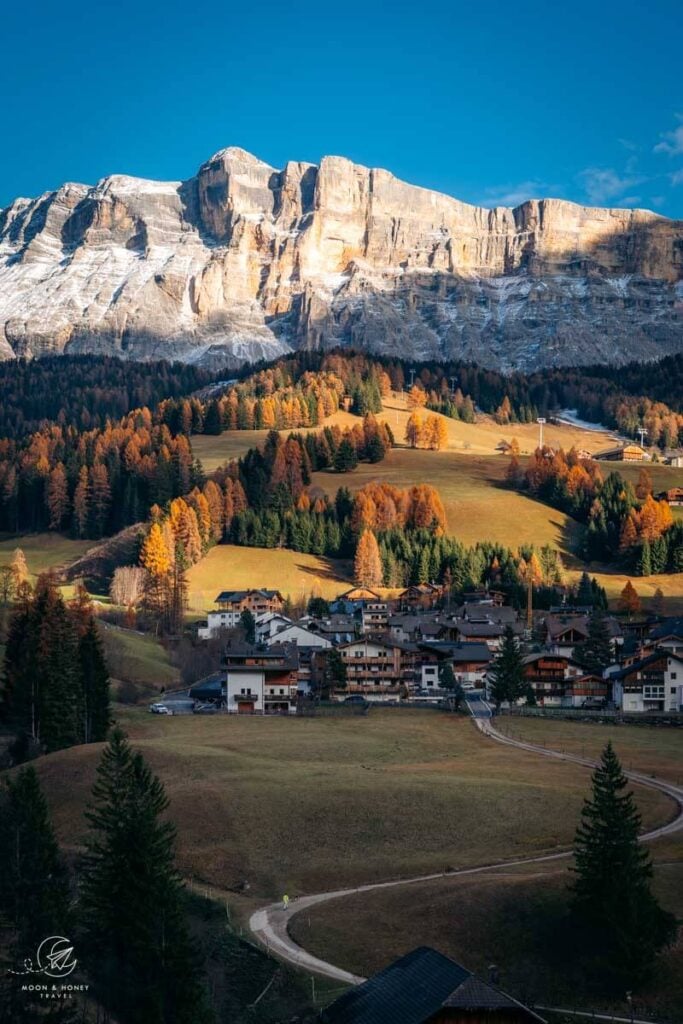

Alta Badia is a mountain region and ski resort in the upper part of Val Badia (Hochabtei) in South Tyrol, nestled between the Fanes, Puez, Sella mountains.
Tucked deep into the mountains, getting to Alta Badia always feels like a journey in itself. From Bruneck and Val Pusteria, it’s about a 45-minute drive to Badia along a narrow, winding road that demands a bit of caution. From Val Gardena, you’ll cross the Gardena Pass, while from Cortina d’Ampezzo, the route takes you over the Falzarego Pass.
Despite having a direct bus connection from Bruneck and sitting between Val Gardena and the Ampezzo Valley, Alta Badia somehow still flies under the radar. And because it doesn’t have as many headline attractions as its neighbors, it often gets skipped over, which is a shame.
During the summer season, it’s easy to visit Alta Badia without a car, thanks to the reliable and regular local bus lines. However, if you visit Alta Badia in autumn, a car is recommended.
Keep in mind that Alta Badia, located on the Sella Ronda, is one of the most popular destinations for cycling. Roads can feel congested with cyclists in high season, especially the week of Maratona dles Dolomites race (usually early July).
For an in-depth look at where to stay in Alta Badia, read our Alta Badia hotel guide.
Why Stay in Alta Badia
Storybook Landscapes
Harboring some of the most enchanting landscapes in the South Tyrolean Dolomites, Alta Badia is the place to go when you want to step into a fairy tale.
A big part of the valley’s appeal lies in its scattered farm hamlets (viles), dotted across the mountainsides. These clusters of historic farmsteads are protected and give Val Badia its distinctive charm.
For a romantic introduction to the region, begin your trip with the Armentara Meadows plateau walk and the Sass de Putia Circuit Trail.
Family-Run Luxury Hotels
Largely family-run, the hotels in Alta Badia are among the finest in the Alps. Staying in a luxury property here typically means excellent gourmet dining, extensive wellness facilities, and refined alpine-contemporary design.
From a culinary perspective, Alta Badia is a real standout destination. Hotel chefs draw on the crossroads of Italian, Austrian, and Ladin traditions, creating inventive multi-course menus you won’t find anywhere else. And thanks to the ski culture, the mountains are peppered with gourmet huts that double as excellent hiking destinations in summer.
Several hotel restaurants even boast Michelin Stars, including Badia Hill (Porcino), Hotel Ciasa Salares (La Siriola restaurant) and Hotel La Perla (La Stüa de Michil).
Another thing we love about Alta Badia luxury hotels are their integrated wellness and spa areas. Take a look at the saunas, swimming pools, and relaxation rooms of Badia Hill in Badia, Hotel Cristallo in La Villa, Hotel Kolfuschgerhof in Colfosco, and Hotel Fanes in San Cassiano.
Riveting Hiking Trails

With a base in Alta Badia, hikers can access vast plateaus like Gherdenacia Plateau, high-alpine grazing areas like Fanes Alp, mountain lakes like Lake Pisciadù and Lake Lagazuoi, and rolling meadows like Armentara and Störes.
Learn More: Alta Badia Summer Guide
Alta Badia Villages
There are six alpine villages in Alta Badia:
- Colfosco (Kolfuschg in German, Calfosch in Ladin)
- Corvara (Kurfar in German, Corvara in Ladin)
- La Villa (Stern in German, La Ila in Ladin)
- Badia (Abtei in German, Badia in Ladin)
- San Cassiano (St. Kassian in German, San Ciascian in Ladin)
- La Valle (Wengen in German, La Val in Ladin)
Colfosco
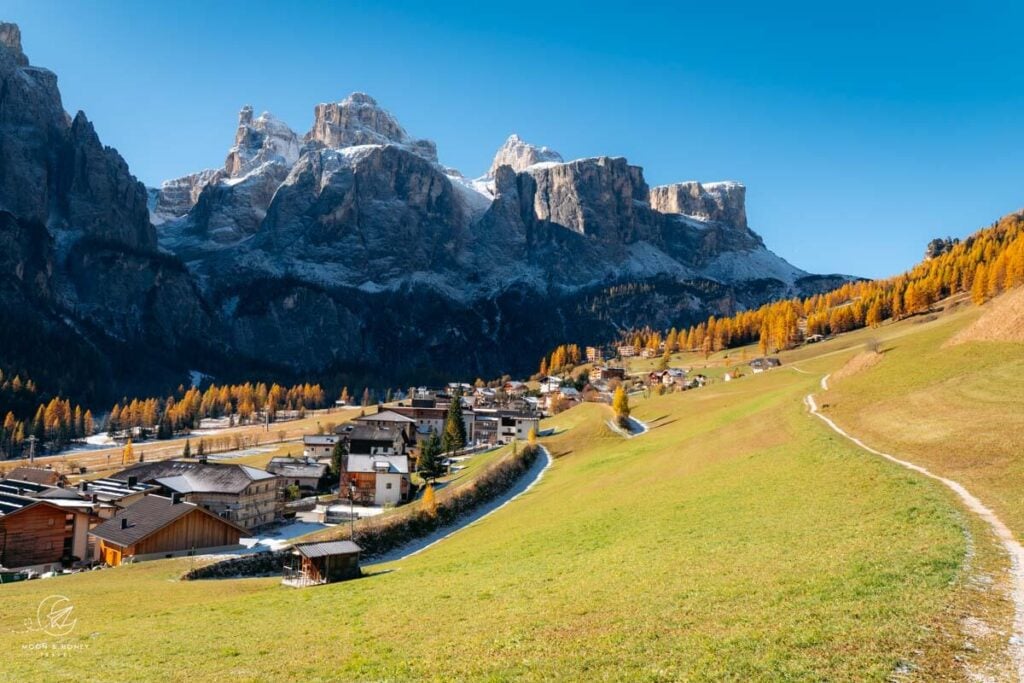
Situated between Corvara and Passo Gardena, Colfosco is the highest village in Val Badia. It’s a great place to stay for its sweeping views of the Sella Massif, direct access to hiking trails, and high-quality accommodations.
The village is fairly spread out, with many properties and gear shops lining the main road. While the Parish Church of St. Vigilius can be considered a focal point, Colfosco doesn’t really have a traditional village center or central square atmosphere.
If you base yourself in Colfosco, hike up the Colfosco High Trail to Passo Gardena (reverse if you’d rather descend). Take a bus to Passo Gardena to tackle the Gran Cir, Sass da Ciampac, and Cima Pisciadu summits. Don’t leave without buying some local specialities at La Spezialité.
Best Places to Stay in Colfosco | Ciasa Altonn (apartments), Crëp Sella (B&B), Hotel Jägerhof (3-star hotel with excellent restaurant), Mountain Hotel Mezdi (4-star hotel), Hotel Recort (new 4-star hotel), and Romantik Hotel Cappella (5-star hotel).
Where we stayed – Luxury Apartments | Lüch de Costa is a stylish aparthotel in Colfosco. In 2017, this historic farmstead was transformed into several high-end apartments. This is a great place to stay if you want the independence of an apartment but the convenience and finer features of a hotel (spa area, indoor pool, outdoor whirlpool, breakfast, daily room cleaning). My only critique is that the breakfast was fairly modest.
Top choice – Luxury | Hotel Kolfuschgerhof excels on every level, from its excellent wellness facilities and superb Dolomites views to its fine dining, featuring local and Italian cuisine. Design-wise, the hotel is a winning combination of Tyrolean chalet-style and alpine-modern. Expect extraordinary service and the best spa views of your life.
Corvara


Set at the foot of Sassongher peak, Corvara sits in a central position in Val Badia, between La Villa and Colfosco. While it’s the main tourist hub of Alta Badia, it doesn’t have a defined pedestrian center. Even so, it’s easy to get around on foot and there are some nice gathering spots in the village like L’Got (cocktail bar), Toccami Wine-Bar Cocktail-Lounge in Hotel Marmolada, L’Murin Corvara (après-ski bar), L´ostì Corvara (restaurant), and La Stüa de Michil in Hotel La Perla.
If you’re traveling without a car, stay in Residence Villa Trieste (apartments), B&B La Tranquillitè (B&B), Berghotel Ladinia (darling guesthouse with excellent restaurant), Hotel Col Alto (4-star hotel), Ciasa De Munt Lifestyle Living (4-star hotel), Hotel Arkadia (adults-only hotel), or La Perla (5-star hotel).
All of these accommodations are within walking distance of the Col Alt gondola (the first ski lift ever built in Italy), which links Corvara to the Pralongià High Plateau, and the Boé gondola, which connects the village to the Sella Group.
During our stay in Hotel Col Alto, we took the bus to Passo Gardena, hiked up to Pisciadu Peak, and then descended all the way back into Corvara. During another stay, I hiked up to to Pralongià High Plateau. And most recently, we stayed in Hotel Posta Zirm (read our Hotel Posta Zirm review).
Family-friendly Aparthotel | Movi Family Apart-Hotel offers new and stylish apartments for families. This modern property blends everything we love about a hotel (amenities and breakfast buffet) with everything we love about an apartment (self-sufficiency and space). Extra Perks: kids and family spa area with pool, adults-only spa, summer outdoor playpark, entertainment for kids.
Midrange | Ciasa De Munt Lifestyle Living strikes just the right balance between urban and the outdoors, with its clean aesthetic, modern elegant lines and location. A fresh breakfast buffet is laid out each morning.
La Villa
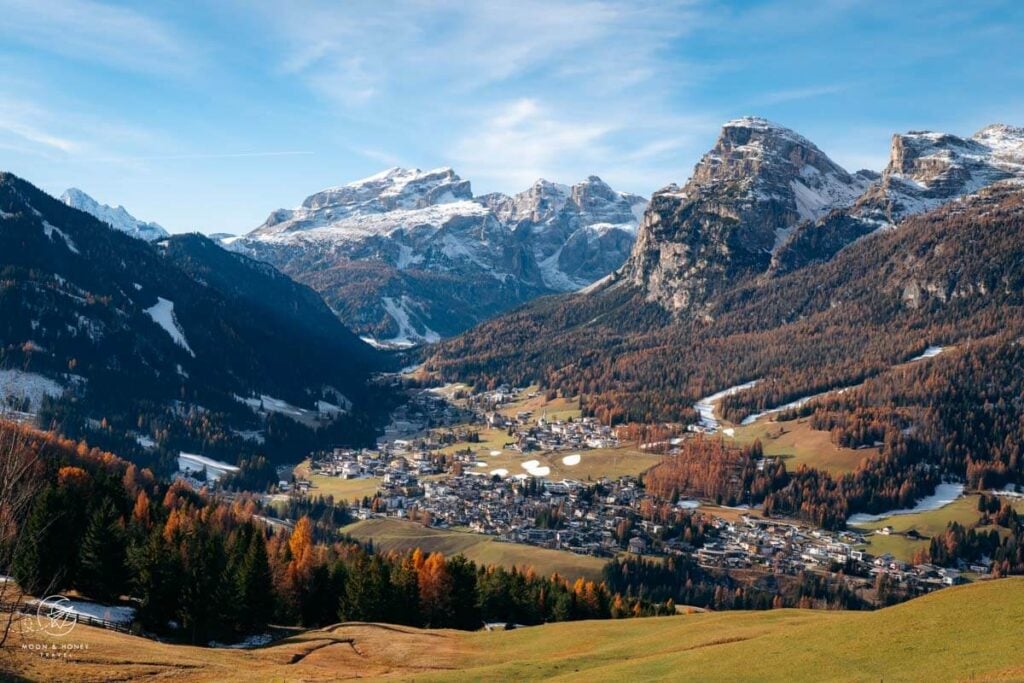
Located between Corvara, Badia, and San Cassiano, La Villa is a central base for exploring Val Badia and the Puez – Odle and Fanes-Senes-Braies Nature Parks. Like nearby Badia, it enjoys splendid views of La Crusc and Conturines mountains.
However, because it sits at the crossroads of the main Val Badia roads, the center often feels congested and busy with traffic. If you’re traveling with a car, I quite like the isolated locations of 3-star Hotel Rezia, which is poised above the village center, and 4-star Miraval NaturHotel, situated north of the village.
During our car-free stay in Hotel Ciasa Soleil, we took the Gardenaccia chairlift up into the Puez mountains and hiked to Rifugio Gardenacia and Rifugio Puez. We also hiked from Capanna Alpina to the Fanes Alp.
Ciasa Agreiter in La Villa (apartments), Hotel La Majun (4-star hotel), and Pensione Camoscio (guesthouse) are all great options for car-free stays as well.

Hotel Ciasa Soleil
4 star hotel in La VIlla
Hotel Ciasa Soleil is an intimate boutique hotel, perfect for car-free travelers. Thoughtfully designed, it charms guests with its Fanes-facing dining room, indoor swimming pool, wellness area, and delicious half board dining.
A huge benefit to staying here is being able to participate in a number of hotel-organized excursions. When you arrive, you’ll be handed a weekly program, outlining all the hiking and cultural excursions available to you, free of charge. You just need to sign up the night before by 5 pm to secure your place.
We loved that Hotel Ciasa Soleil makes each day special. Some days you’ll be given a welcome aperitif before dinner. Other days, you’ll be treated to a traditional Ladin dinner or an indulgent dessert buffet.
Badia
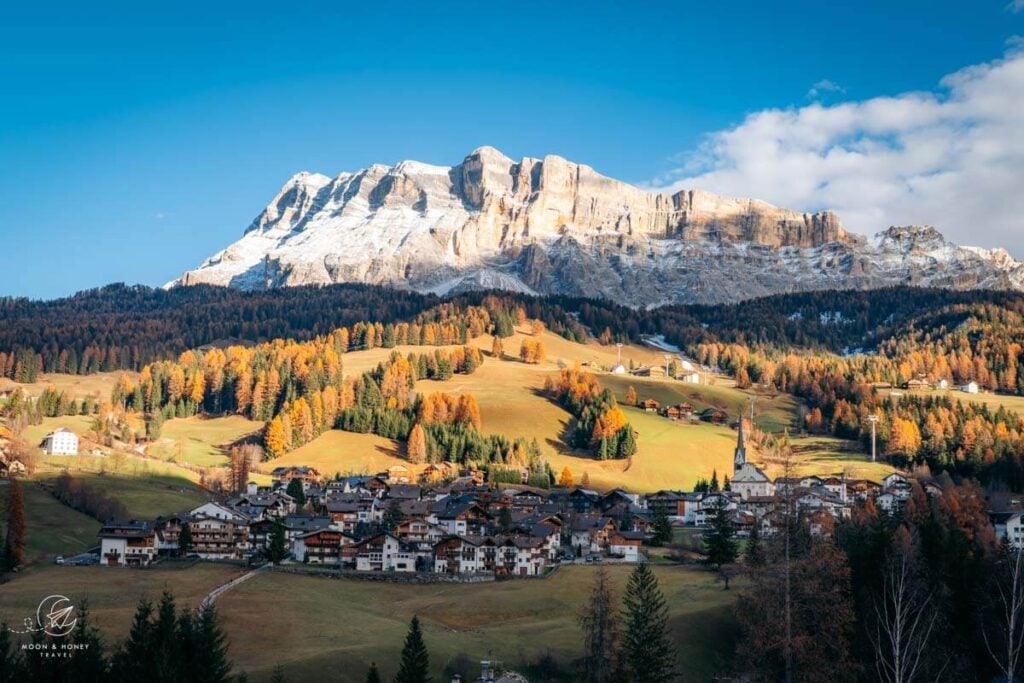
Badia (Abtei in German), located between La Villa and La Val, lies at an elevation of 1315 meters. Compared to the other Val Badia villages, you’ll find more farm stay and budget-friendly stays here like Niciora (apartments), Agriturismo Anví (farm stay), Lüch Runch Hof (farm stay), and Residence Lersc (apartments).
The La Crusc gondolas connect Badia with Santa Croce Sanctuary (2045 m), a pilgrimage church set below the impressive rock faces of Sasso di Santa Croce Group (Sas dla Crusc in Ladin, Kreuzkofel in German). From here, hikers can walk down to Badia via the Armentara Meadows, the easiest and most enchanting walk in the valley.
When based in Badia, I recommend visiting La Val. Walk up to the Chiesa di Santa Barbara and eat lunch at the local Ostaria Vedla tavern, or hike to Piz de Pares and eat at Ütia Da Rit. Another day, drive to Longiarù to hike to Ütia Ciampcios and Kreuzjoch.
Where to Stay in Badia | Chalet Ciasa Nene Franzl (apartments), Hotel Cavallino (3-star hotel), Hotel La Müda (4-star hotel), or Hotel Melodia del Bosco (4-star hotel)
Badia Hill
4-star hotel in Badia
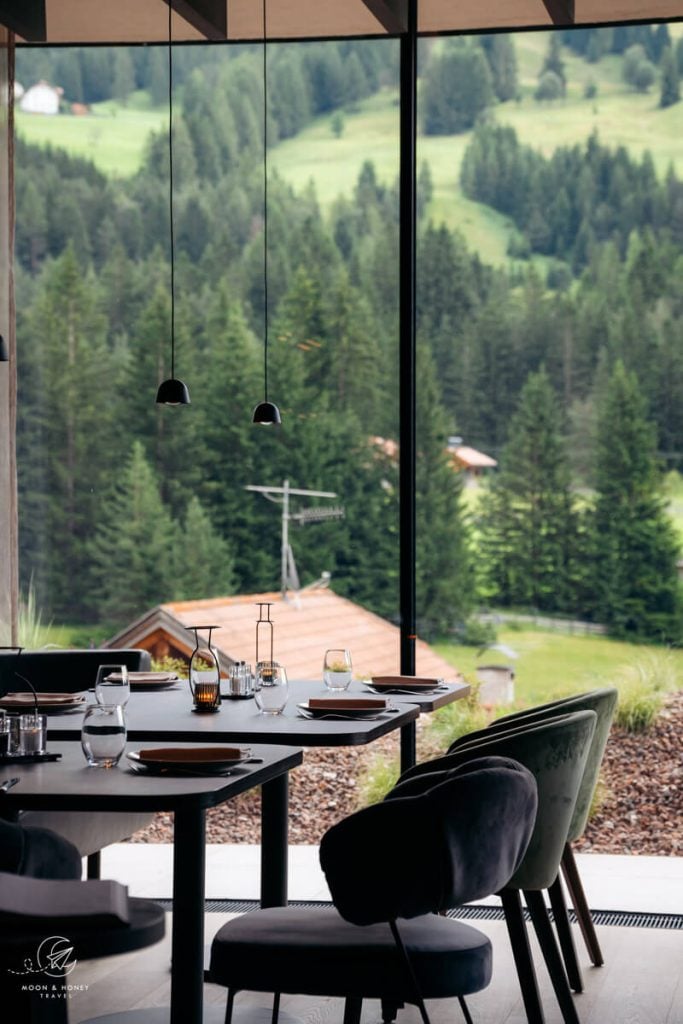
Badia Hill is an alpine-modern masterpiece with elegant and spacious communal areas, harmonious lighting and color schemes, and nature-inspired accents.
Guests can marvel at the Dolomites mountains from all spaces, including the lounge, wine bar, Porcino restaurant, rooftop wellness area, and panoramic infinity pool.
Read our Badia Hill hotel review.
San Cassiano
Beneath the impressive Lavarela and Conturines peaks lies the charming alpine village of San Cassiano. In its pedestrian zone, you’ll find the Ursus ladinicus museum, dedicated to the prehistoric cave bear and the geology of the Dolomites.
With or without a car, hikers are well-positioned to tackle numerous hikes in Fanes-Sennes-Braies Nature Park like Lake Lagazuoi, Fanes Alp and Path of the Larches. Venture to Passo Varparola to hike the Setsas Circuit Trail or the Kaiserjägersteig to Rifugio Lagazuoi and across Passo Falzarego to hike Cinque Torri and Tofana di Rozes.
Also, hikers and mountain bikers can explore the main trails of Pralongià High Plateau including Störes Meadows.
San Cassiano has many wonderful accommodations ranging from farm stays like Plang Farmhouse B&B to 5-star spa hotels like Hotel Fanes. The most central accommodations are Ciasa Milandura (apartments), Hotel Conturines (3-star hotel), Hotel Diamant (4-star hotel), Hotel Steinrösl (3-star hotel), and Lagació Hotel Mountain Residence (4-star aparthotel).
Outside of town, Camping Sass Dlacia is a budget-friendly option, located at the entrance of Fanes-Sennes-Prags Nature Park. Set at the foot of Sass Dlacia and ringed by pine forest, travelers can choose between the guesthouse, rustic huts, and camping options. Extra perks: Natura Wellness and sauna area and on-site pizzeria restaurant.
Passo delle Erbe
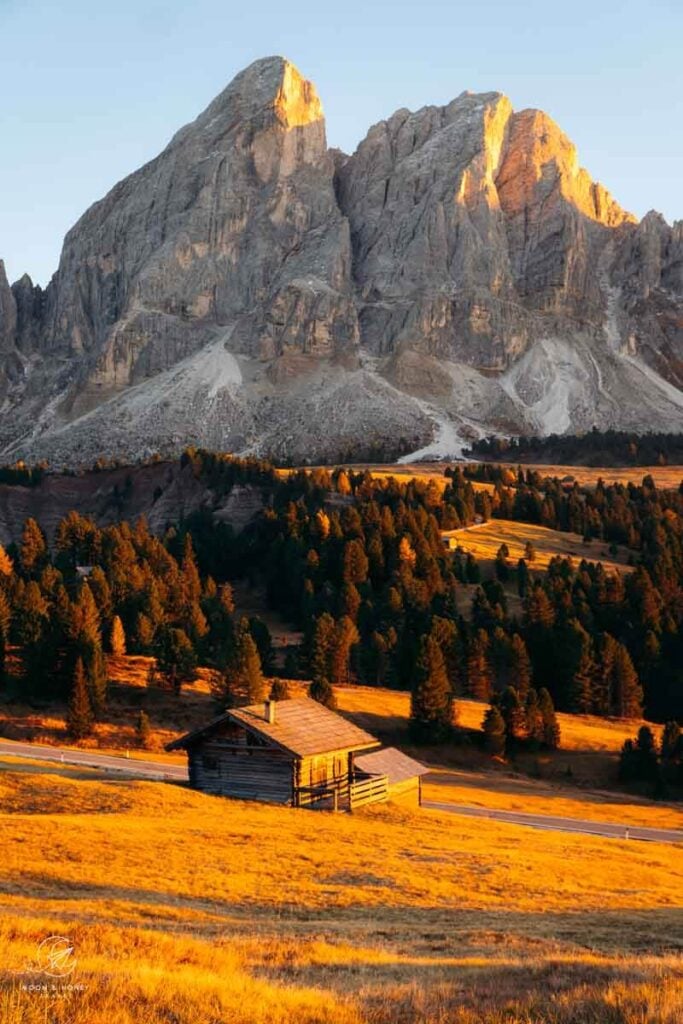
Passo delle Erbe is a high mountain pass above San Martin de Tor. We loved staying at Ütia de Börz, which stands directly at the pass. From here, we hiked the circuit trail around Sass de Putia.
Ütia de Börz
3 star hotel
Ütia de Börz is an upscale mountain refuge situated at Passo delle Erbe.
Facing the majestic north-face of Sass de Putia/Peitlerkofel and the Odle di Eores/Aferer Geisler mountains, this remote accommodation offers guests the feeling of being blissfully alone in the mountains, but with all of the comfort.
4. Alta Pusteria
Alta Pusteria/Hochpustertal is the best place to stay for exploring the Braies/Prags Dolomites and the Northern Sesto/Sexten Dolomites.
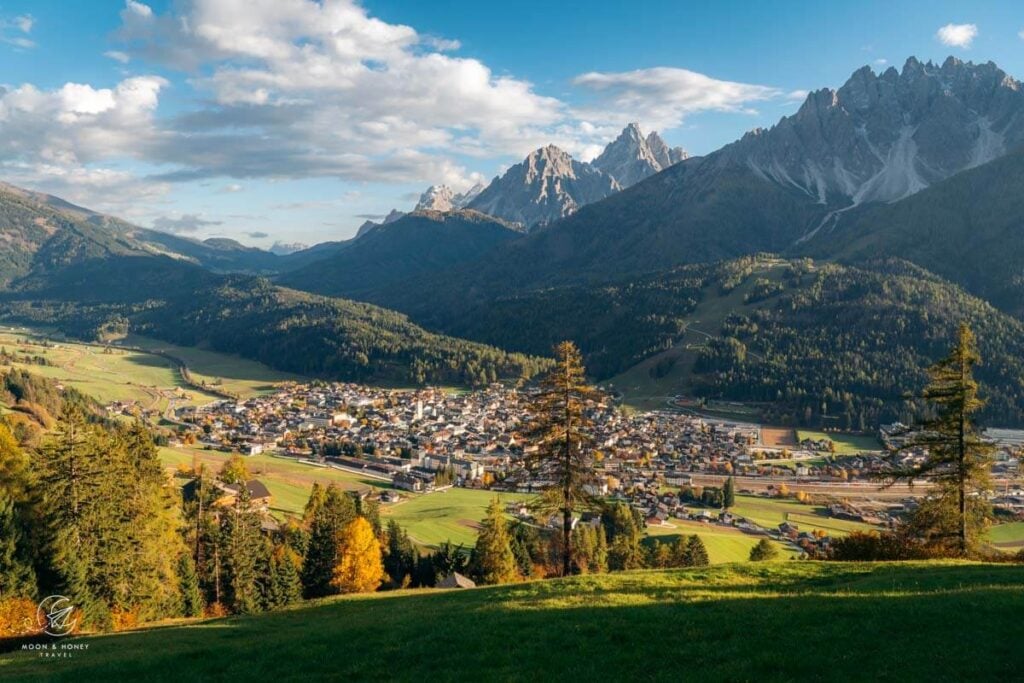
The Puster Valley is a long Alpine valley stretching from Bressanone (Brixen) in Italy to Lienz in Austria. The Upper Puster Valley (Alta Pusteria in Italian, Hochpustertal in German) refers to the easternmost section in South Tyrol, encompassing the villages of Villabassa, Dobbiaco, San Candido, Braies, and Sesto.
This area is also known as the “Three Peaks” holiday region, a name derived from the branding of the 3 Zinnen Dolomites ski resort.
Learn More: Alta Pusteria Travel Guide
Why Stay in the Upper Puster Valley
Dazzling Mountains, Plateaus, and Lakes
Upper Puster Valley is the northern gateway to the Sesto/Sexten Dolomites and the Braies/Prags Dolomites. It’s the perfect base for anyone who wants to visit:
Vallon Popera. This stunning basin in the Eastern Sexten Dolomites is home to Rifugio Berti and the tiny Lago di Popera. Here’s my guide to the Kreuzbergpass – Vallon Popera circuit trail.
Tre Cime di Lavaredo / Drei Zinnen. There are so many ways to ascend to the famous Three Peaks. The easiest way is to drive the Rifugio Auronzo toll road to the south side of Tre Cime di Lavaredo.
From here, you can follow the magnificent circuit trail around Tre Cime di Lavaredo. Don’t forget to detour to the Cadini di Misurina viewpoint from Rifugio Auronzo. A more thrilling ascent to Three Peaks starts in Val Campo di Dentro valley, following the Torre dei Scarperi circuit trail.
Lago di Braies / Pragser Wildsee Lake. Lake Braies is located in Braies Valley, a side valley of Val Pusteria. Insider tip: you can hike to Hochalpenkopf from Lago di Braies.
Prato Piazza / Plätzwiese High Plateau. From Prato Piazza, I recommend hiking to the summit of Monte Specie / Strudekopf and following the Gaisl High Trail to Malga Rossalm.
Val Fiscalina / Fischleintal Valley. Val Fiscalina is a side valley of Sexten Valley. We started this 3-day hut-to-hut hike to Tre Cime in Val Fiscalina.
Prati di Croda Rossa / Rotwandwiesen Meadows. The Prati di Croda Rossa (Rotwandwiesen in German) meadows lie at the foot of the Croda Rossa di Sesto / Sextener Rotwand mountain in the northern Sexten Dolomites.
This scenic, family-friendly destination is accessible by cableway from Sesto Moso/Sexten Moos, adjacent to the Bad Moos Dolomites Spa Resort. From Prati di Croda Rossa, you can hike to Passo Monte Croce.
Carnic Alps
Alta Pusteria is bound by the Dolomites to the south and the Villgraten Mountains and Carnic Alps to the north, which form the natural border between Italy’s South Tyrol and Austria’s East Tyrol.
Not only do the Carnic Alps afford some of the most awe-inspiring views of the Sexten Dolomites, they also boast some of the largest alpine pastures in the region.
My favorite hike is from Stiergarten, accessible by gondola from Signaue, to Klammbachalm and Alpe Nemes Hütte. Another great hike is the loop trail from Kreuzbergpass to Casera di Coltrondo, Casera di Rinfreddo, and Nemes Hut.
We’ve also hiked along the Carnic High Trail from the Helmjet Cableway mountain station to Sillianer Hütte and Klammbachalm mountain pasture, but found it a bit frustrating due to the mountain bikers.
Upper Puster Valley Villages
- Villabassa (Niederdorf in German)
- Dobbiaco (Toblach in German)
- San Candido (Innichen in German)
- Braies (Prags in German)
- Sesto (Sexten in German)
Sexten

Cradled by the Northern Sexten and Carnic Alps, Sexten is one of the best bases in Alta Pusteria for car-free travelers. Its side valleys, Val Fiscalina (Fischleintal) and Val Campo di Dentro (Innerfeldtal), lead directly into the heart of the Tre Cime Nature Park. Regular bus services connect Sexten with Kreuzberg Pass, the starting point for the Vallon Popera hike, numerous Carnic Alps trails, and the Rotwandwiesen meadows.
Here’s my guide to where to stay in Sexten based on countless trips.
Top accommodations in Sexten: B&B Grüne Laterne (guesthouse and restaurant), Hotel Schoenblick (3-star hotel), Hotel Royal (3-star hotel), Hotel Alpenblick (4-star hotel with farm-to-table restaurant), Aparthotel Gamz (aparthotel), Hotel Monika (5-star spa hotel).
I wrote about our experience staying in Bad Moos Dolomites Spa Resort and Hotel Dolomitenhof in Best Hotels in the Dolomites. Most recently, during our Sexten winter hiking trip, we stayed in Alpenwellness Hotel St. Veit (read our Hotel St. Veit review).
San Candido
Beneath the craggy Monte Baranci (Haunold), named after the legendary local giant, the historic village of San Candido (Innichen) is the most atmospheric village in Val Pusteria.
In the pedestrian town center, cafés are always buzzing with patrons, who elegantly drink Apéritifs throughout the day. Locals merrily greet each other with exuberant waves and friendly smiles. And, visitors weave in and out of shops, determined to find the perfect memento.
Notable landmarks include the Collegiate Church of San Candido (Stiftskirche Innichen) and St. Michael parish church, dating back to the 12th century.
San Candido is a great base for travelers without a car, since the town is accessible by train and multiple bus lines. If you want to base yourself in San Candido, read Where to Stay in San Candido to plan the perfect trip.
Take a look at Residence Kugler (apartments), Wachtler Dolomite Apartments (town center apartments, see Wachtler Apartments review), ATTO Suites & Cuisine (luxury apartments and restaurant), Boutique & Gourmet Hotel Orso Grigio (4-star town center hotel), Post Hotel (adults-only town center hotel).

Naturlhotel Leitlhof
4 star superior hotel in San Candido
Naturhotel Leitlhof, a GSTC certified and climate-neutral hotel, occupies a private and peaceful location overlooking the village of San Candido. Nestled against the forest line, this secret oasis looks like the residence of a magical forest sorceress.
I loved staying here, because of the Sexten mountain views, panoramic outdoor pool, extensive wellness area, and spacious bedrooms.
But perhaps the best part about staying here is the rich breakfast buffet and the gourmet dinner (half board is a must). The hotel kitchen sources their vegetables, herbs, and beef from local producers and their very own Mühlhof farm. Everything we ate was exquisitely prepared and bursting with flavor.
Learn more: Naturhotel Leitlhof Hotel Review
5. San Martino di Castrozza
San Martino di Castrozza is the best base for exploring Pale di San Martino, the largest mountain group of the Dolomites.
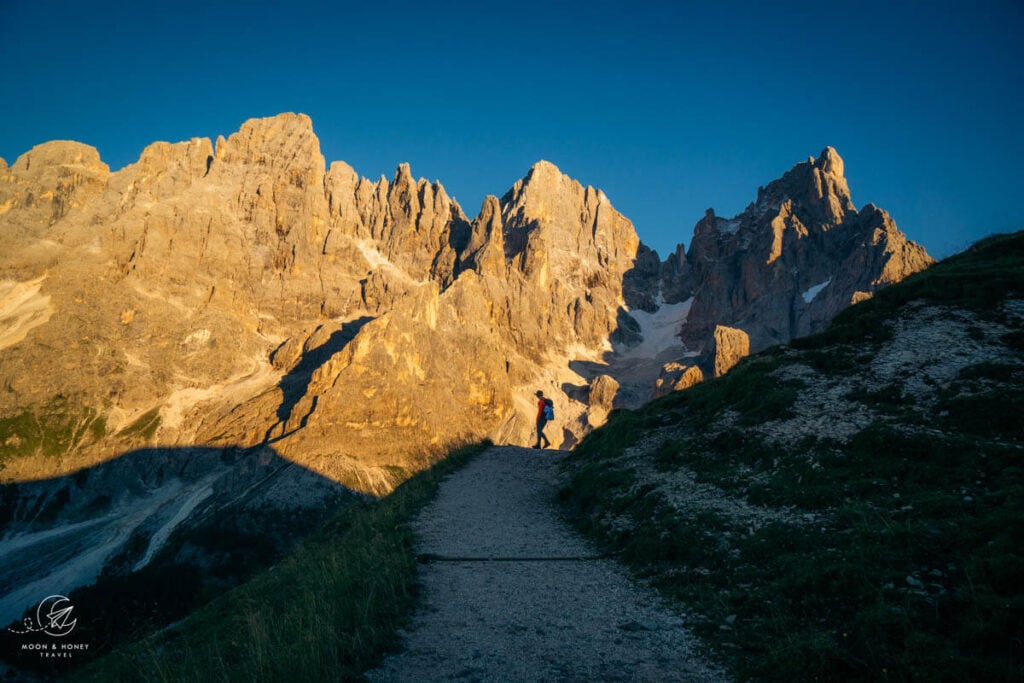
San Martino di Castrozza is an alpine resort town in the Primiero valley in the Italian province of Trentino.
Located in a green basin and framed by the Pale di San Martino and the Lagorai mountain ranges, San Martino di Castrozza is one of the most visually spectacular towns in the Italian Dolomites.
The town is a mere 15-minute drive to Passo Rolle, a 35-minute drive to Val Venegia, and a 35-minute drive to Val Canali.
Why Stay in San Martino di Castrozza
Gateway to Pale di San Martino
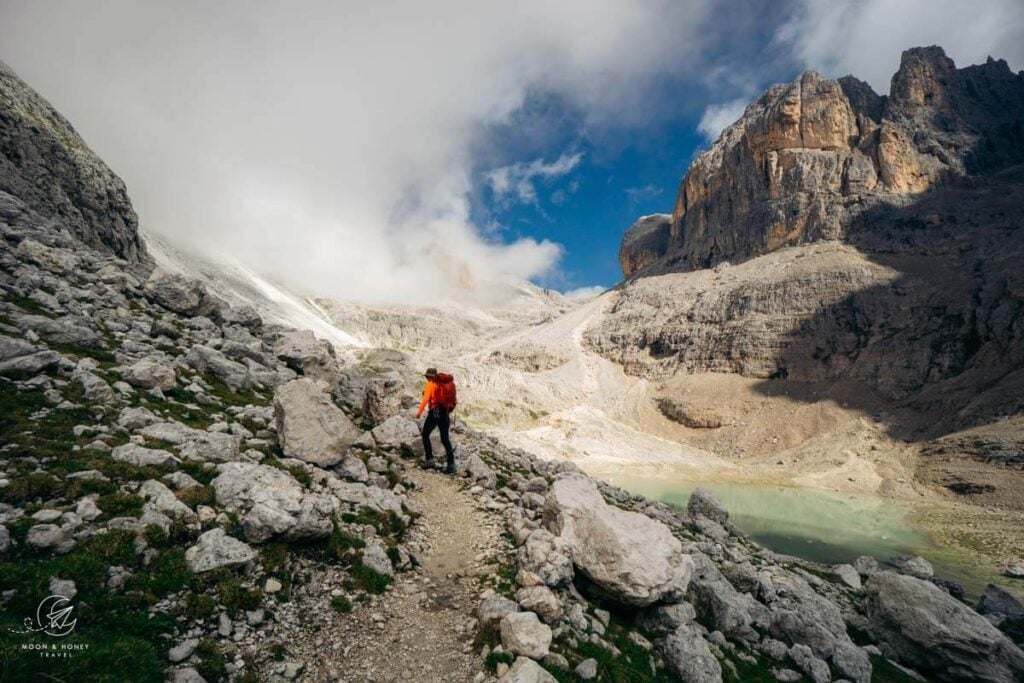
San Martino di Castrozza is a lively resort town, filled with shops, cafés, restaurants, hotels, and apartments. Most importantly, it’s the gateway to Paneveggio-Pale di San Martino Nature Park, which encompasses the Pale di San Martino (aka Pala Group), the forest of Paneveggio, and the Lagorai chain.
The main reason to stay in San Martino di Castrozza is to hike and climb in the Pale di San Martino, the largest mountain group in the Dolomites.
Millions of years ago, the Pala Group was an atoll, a ring-shaped coral reef, in the Tethys Ocean (source). The jagged mountains you see today are these ancient coral reefs, which have been shaped by the elements over millennia. In more poetic terms, the Pala Group looks like the summer residence of the Olympian gods. Each peak looks like a throne, or a mighty spear piercing the sky.
From the town center, you can hop on the Colverde Gondola followed by the Rosetta Cableway to get to Altopiano delle Pale di San Martino, a vast stone plateau in the heart of the Pala Group. From here, you can embark on thrilling hikes like the tour of Pala di San Martino and Cima della Vezzana.
While based in San Martino di Castrozza, visit Val Venegia and hike to Hike to Rifugio Mulaz, drive up to Passo Rolle to hike the circular route to Baita Segantini and Monte Castellaz, and loop around Pala di San Martino.
Where to Stay in San Martino di Castrozza
Budget | Residence Taufer is an affordable apartment-style accommodation, located 1 km from the center of San Martino di Castrozza.
Midrange | Hotel Vienna is a welcoming family-run hotel, set in the heart of San Martino di Castrozza. This 3-star hotel delivers gorgeous mountain views, cozy and spacious rooms, and a great breakfast. The staff is very friendly and helpful.
Luxury | Sayonara Nature & Wellness Hotel is a top-rated luxury hotel in San Martino di Castrozza. Stay here for the spacious, alpine-modern rooms, the rich and varied breakfast buffet, and the 1000 m2 spa and wellness area. The hotel is a 5-minute walk to the center of town. The hotel’s on-site restaurant is open daily for dinner.
Look for accommodation in San Martino di Castrozza.
6. Val di Funes
Val di Funes is the best place to stay for a romantic getaway.

Val Di Funes (Villnößtal) is a 24-kilometer-long valley stretching from the Valle Isarco (Eisacktal) to the Odle (Geisler) mountain range. The entrance of the valley is located 8 km south of Brixen and about 5.5 km north of Klausen. While some visitors base themselves in Klausen or Brixen to explore Val di Funes, nothing compares to staying in the valley itself.
Why Stay in Val di Funes
Iconic Dolomites Scenery
What makes the Dolomites so captivating? For me, it’s the juxtaposition of rugged and polished beauty. It’s the continuous play between the wild and the tame. In Val di Funes, these scenic contrasts are epically pronounced.
The jagged, razor-sharp Odle peaks jut out of rolling green pastures. Tiny stone chapels are dwarfed by mammoth spires. And, intimidating sawtooth peaks form the background of cozy alpine pasture huts.
Charming Alpine Pasture Huts
Alpine Pasture Huts (Baita/Malga in Italian, Alm/Schwaige in German) are huts situated on alpine pastures, surrounded by grazing cows, horses, and sheep. These huts were constructed to provide shelter for the shepherds and herdsmen who managed the livestock during the summer pasture months.
Unlike a Rifugio (mountain shelter), Malgas usually don’t offer overnight lodging. However, they do serve warm food and sometimes fresh dairy (yogurt, cheese, and sour milk), which they produce on-site.
These alpine pasture huts usually prepare their food using homemade products and local ingredients.
Val di Funes is peppered with these huts. Head to the Zannes/Zans trailhead and hop on the Adolf Munkel Trail or this Rifugio Genova circuit to visit a few.
Quiet Hiking Trails
If you’re seeking quiet trails away from the masses, consider hiking the Oberer Herrensteig and the Günther Messner Steig.
You can follow these paths all the way to Tullen, the highest summit in the Odle d’Eores/Aferer Geisler Group. This is one of our favorite hikes in Puez-Odle and very few people know about it.
Val di Funes Villages
There are three villages in Val di Funes:
- Tiso (Teis in German)
- S. Pietro (St. Peter in German)
- Santa Maddalena (St. Magdalena in German)
Santa Maddalena
Santa Maddalena is located in the upper part of Val di Funes at an elevation of 1339 meters.
Based in the village, you’re well-positioned to access the main attractions of the valley including the Santa Maddalena Church, the Santa Maddalena Panoramic Trail, Church of St. John of Nepomuk (Chiesetta di San Giovanni) in Ranui, and the Zannes/Zans trailhead in Puez-Odle Nature Park.
I recommend staying at Appartements Pension Sonia (budget), Fallerhof (farm stay), Hotel Fines (3-star hotel and restaurant), Proihof (farm stay), or Galreidhof (apartments).
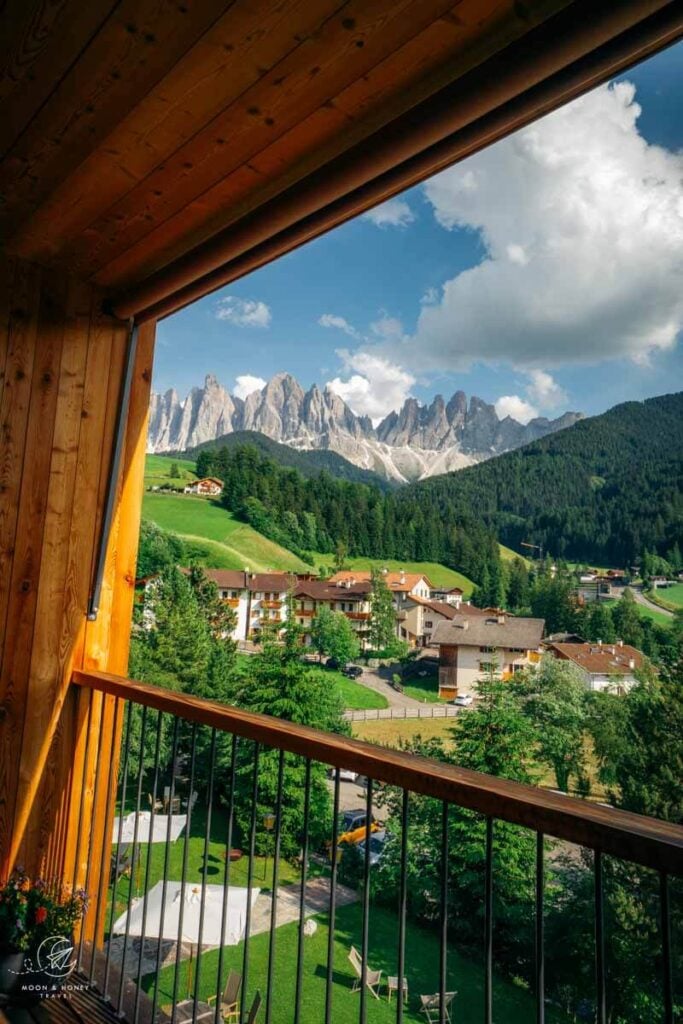
Hotel Tyrol
4 star hotel in Santa Maddalena
Hotel Tyrol is the finest accommodation in Santa Maddalena, spoiling guests with its perfect location, Odle/Geisler peak views, and delicious local cuisine (book half board).
From the hotel, you can walk to the Santa Maddalena Church in 10 minutes, the Santa Maddalena viewpoint in 20 minutes, and continue along the rewarding Panoramic Trail afterwards. You can also savor the mountain views directly from the hotel garden, or your bedroom balcony (make sure to book a room with a “Geisler Blick”).
Hotel Tyrol heartily invites guests to slow down and luxuriate in the hotel’s magical surroundings. Relax and read by the pool, soak in the whirlpool, drink an Apéritif on the terrace, and relish the seasonal food.
7. Alpe di Siusi
Alpe di Siusi is the best place to experience sunrise and indulge in gourmet local South Tyrolean food.

The rolling Alpe di Siusi (Seiser Alm in German, Mont Sëuc in Ladin) plateau stretches between the Sassolungo/Langkofel Group and the Sciliar/Schlerf massif, high above Val Gardena and Siusi in South Tyrol.
The road to Seiser Alm is restricted. However, overnight guests can drive to their accommodation at any time. You do need to show your booking confirmation at the checkpoint in St. Valentin to drive the road up to Compatch.
Why Stay on Alpe di Siusi
Alpe di Siusi is a great base for travelers who want to exclusively explore the plateau and immediate surroundings on foot or by bike for a few days. However, it’s not a great place to stay, if you want to drive to other destinations in the Dolomites due to the remote location and traffic restrictions on the plateau.
I recommend staying on the plateau between mid-June and mid-July when the wildflowers are in bloom. I would avoid July and August, because the plateau is overrun with visitors.
Magical Sunrises
Experiencing sunrise atop Alpe di Siusi is like stepping into a bewitching realm, where light and shadow perform an eternal dance for each other.
First, the long ridge of Sciliar burns like a red flame, reminding you of the pagan rituals that long transpired atop the Sciliar plateau. Then the sun rays drench the meadows in shades of gold.
The light seems to sanctify everything in its direct path. And finally, the Sassolungo Group transforms slowly into a perfect violet silhouette.
If you visit Alpe di Siusi in early summer, sunrise is around 5:15 am. Staying on the plateau affords you the ability to experience sunrise with very little effort.
We relished our early morning walk, knowing that after sunrise, we could walk back to our hotel, Hotel Steger-Dellai, and indulge in a rich breakfast buffet.
Gourmet Huts
Alpe di Siusi harbors numerous gourmet alpine pasture huts.
With a few nights on the plateau, you can drink wine at Rauchhütte, eat the hay flower soup (Heublütensuppe) at Gostner Schwaige, taste Tyrolean and Ladin cuisine at Baita Sanon, and visit a dozen more huts scattered across the mountain pasture.
Follow the Hans and Paula Steger Trail, or the Alpe di Siusi Meadows Circuit Trail to visit these standout alpine pasture huts.
Adventurous hikers can scale the Sciliar massif along the thrilling Rifugio Bolzano – Rifugio Alpe di Tires circuit trail.
Excellent Mountain Hotels
Sunrise & Sunset Views | Sporthotel Sonne is the best place to stay if you’re eager to experience dreamy sunrises, where thin veils of mist hover over the rolling pastures, and burning sunsets, where blazing colors mutate from shades of peach and rose to burning hues of crimson and purple. In addition to its prime location, this modern hotel offers a wellness area and an innovative kitchen.
Vegetarian Gourmet Cuisine | Paradiso Pure Living Vegetarian Hotel occupies a uniquely central location on Alpe di Siusi, ideal for hiking. Come here for the excellent, high-quality vegetarian cuisine (breakfast and dinner included in the rate), idyllic setting, and wellness facilities.
5-Star Splurge | Alpina Dolomites is a modern 5-star hotel atop Alpe di Siusi, designed with the philosophy ‘Nature, our origin, is also a basic need, like the air we breathe.” Taking in the full sweep of the Sassolungo/Langkofel and Sciliar/Schlern mountains from its divine location, Alpina Dolomites has panoramic mountain views, a contemporary wellness area, and gourmet restaurant.

Hotel Steger-Dellai
4 star hotel on Alpe di Siusi
Hotel Steger-Dellai is a traditional hotel built by two legendary alpinists: Paula Wiesinger and Hans Steger.
Though still central, Hotel Steger-Dellai is quietly tucked away from busy Compaccio, where people flood in and out throughout the day.
From a hiking perspective, this hotel couldn’t be better positioned.
The best part about staying here is the cuisine (breakfast and dinner). Expect the finest ingredients, sourced from local producers, and the most attentive dining staff in the Dolomites.
The hotel was last renovated in 2000. 20 years later, it feels like the hotel would need a facelift. All the essentials are there, but the aesthetics are dated.
8. Val d’Ega
Val d’Ega (Eggental) is a great place to stay for via ferrata hikes and journeys into the Rosengarten/Catinaccio and Latemar mountains.

Val d’Ega/Eggental is a valley in South Tyrol located between the Catinaccio and Latemar massifs. The valley branches off from Eisacktal at Bolzano and stretches all the way to Val di Fassa.
Why Stay in Val d’ Ega
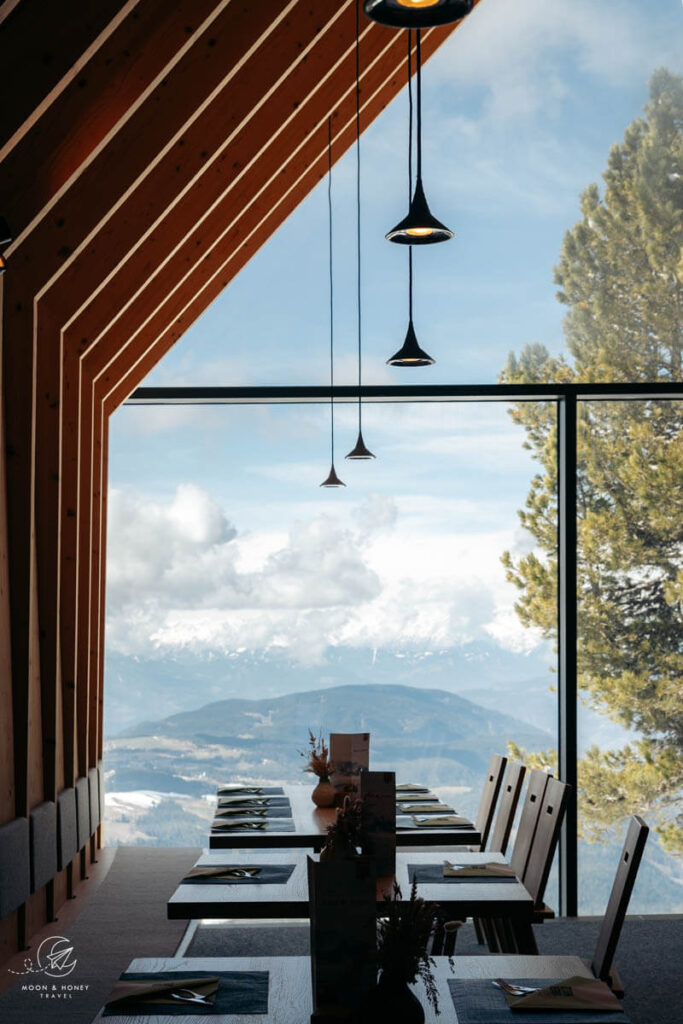

A lot of people make a stop at Lake Carezza (Karersee) on their Dolomites road trips. Emerald-colored Lago di Carezza is an extremely photogenic lake you’ve definitely seen pictures of.
While this lake might be the initial draw, don’t let it be the last. Stay in Val d’Ega for a few nights to explore the beauty of the Latemar and Rosengarten/Catinaccio mountains.
Don’t miss the striking Oberholz Hütte above Obereggen.
You’ll find some more ideas in our brief guide to Sciliar-Catinaccio Nature Park.
Val d’ Ega Villages
There are 7 villages across Eggental:
- Nova Levante (Welschnofen in German, Nueva Ladina in Ladin)
- Carezza (Karersee in German)
- Nova Ponente (Deutschnofen in German)
- Collepietra (Steinegg in German)
- Sopra Ega (Obereggen in German)
- Monte San Pietro (Petersberg in German)
- Ega (Eggen in German)
I recommend staying in Nova Levante or Carezza. I would also consider staying in Tiers am Rosengarten in Tiersertal, which is technically part of the Seiser Alm holiday region (for reasons I do not comprehend), but is geographically closer to Eggental.
We recently stayed in Cyprianerhof Dolomit Resort in Tiers, which sits on the doorstep of Schlern-Rosengarten Nature Park, and LOVED it. It’s an excellent base for those traveling without a car as well as solo travelers. Take a look inside in my Cyprianerhof hotel review.
Carezza

Carezza is a tiny hamlet (blink and you’ll miss it) in Val d’Ega, which enjoys sweeping views of the Rosengarten and Latemar mountains. During our first trip to Val d’Ega, we stayed at Sporthotel Alpenrose, located at the base of the Paolina chairlift, which connects the valley to the Rosengarten range. We loved the half board dining experience, the peak-gazing swimming pool, and views.
With the help of this cableway, you can conquer the Santner Via Ferrata and see the striking Vajolet Towers. You can also start this 3 Day Rosengarten hut to hut hike.
At Passo Carezza (Karerpass) mountain pass, Sporthotel Passo Carezza is a modern structure with 18 comfortable rooms and suites featuring bold patterns and vibrant colors. Breakfast and spa access are included in the room rate. There’s an on-site snack bar and a few restaurants located nearby.
Nova Levante
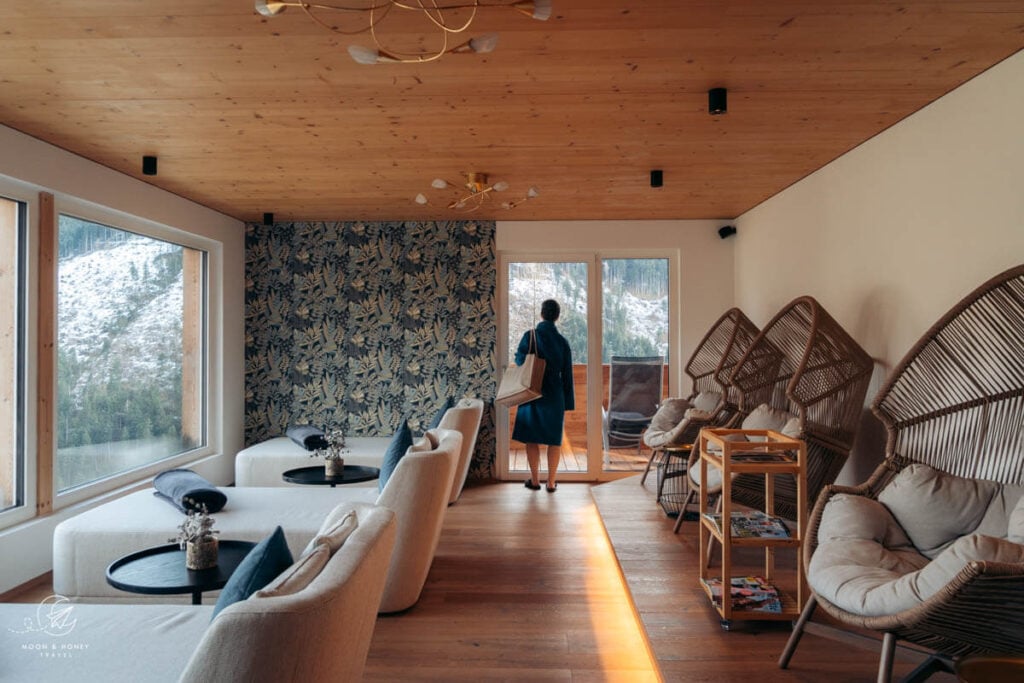
Nova Levante (Welschnofen) is a larger village in Val d’Ega. While it can’t compete with the setting of Carezza, it boasts a wonderful range of midrange accommodations.
We recently stayed in the lovingly-run 3-star Hotel Berghaus Rosengarten during our ski trip to Carezza and Latemar Ski Center and were impressed by the hospitality, the wonderful breakfasts, the cozy lounge, and the small, but darling spa. Breakfast and dinner are included in the rate.
Budget-Midrange | Haus Herta B&B is a guesthouse with sparkling clean rooms. Guests are treated to a delicious homemade breakfast. 2 nights minimum stay.
Midrange | Stern B&B & Suite Apartments is a 3-star superior hotel with a wellness area and indoor pool. Breakfast is included.
Luxury | Tyrol Living & Cafe is a luxurious aparthotel with an alpine-modern aesthetic. Guests love the location, new amenities, and on-site café.
More accommodations: Hotel B&B Pardeller (Budget), Hotel Rosengarten (midrange), and Moseralm Dolomiti Spa Resort (luxury)
Map of the Best Dolomites Bases
How to use this map | Click on each accommodation icon to display further information. Each color signifies a different Dolomites destination.
DOLOMITES REGIONS
Val di Fassa
Val d’Ega
Dolomites Travel Guides
Hotels:
Trip Planning:
- Things to Do in the Dolomites
- Places to Visit in the Dolomites
- Best Time to Visit the Dolomites
- How to Get to the Dolomites
Itineraries:
Hiking:
Winter:

Pin this Image for Future Trip Planning!
Stay Connected:
Connect with us on Pinterest.
Follow us on Instagram.
Like us on Facebook.
Support Us:
If you love reading our content, you can buy us a coffee via Ko-Fi.


Would love to explore more of Italy, Dolomites looks perfect! Thanks for the guide on where to stay, super helpful 🙂
Hi Katie,
What a great article. I am spending 4 nights in the dolomites in July with a friend and we are mostly interested in hiking the best spots. We are planning to start in Venice and finish in Milan with a hire car but I’m finding it difficult to get my head around how to make the most out of the trip. We are from Australia so unlikely to return to this part of the world anytime soon!
Which towns would you recommend to stay for these 4 nights?
Thanks so much
Hi Zoe,
I recommend staying in either Val Gardena or Cortina d’Ampezzo for the four nights, or 2-nights in both locations.
Have a great trip!
Sabrina
Woah, I definitely need to see more of northern Italy, it’s been on the never-ending plans for years! This has given me so many ideas. Definitely going to have to stay in Corvara at the very least!
What a great post! Finding the right place to stay is crucial for the Dolomites as it can be a great base depending if you have a car or not. I stayed just outside of Cortina d’Ampezzo and loved it. The town is so cute and a great place to pick up supplies, and all the hikes I wanted to do were within a 2 hour drive radius. I’d probably stay in that area again when I go back (hopefully soon!)
This is such a beautiful area! I have been wanting to go for several years. I even have a rough itinerary of the places I want to visit and the hikes I want to do. Now, I have a better idea on where to stay.
Awesome post! Haven’t even finished it because I have a question..so, we had planned to stay in Ortisei, but after reading what you wrote about Dorfthotel Beludei – we think it sounds amazing. We will have a car. I see it’s only an 8-minute drive from Ortisei… if we want to get dinner there, could we just do a quick drive over for dinner, coffee, a snack, or whatever? Thanks for your advice!! Xo
Hi Rachel & Clark,
It’s a quick drive to Oritsei from Dorfhotel Beludei. During the high season (July, August, Early September), parking can be a bit tricky. But, there are paid car parks at the Seceda cableways valley station and the Ortisei-Alpe di Siusi gondola valley station. The food at Dorfhotel Beludei will be better than any restaurant food in Ortisei…so you may want to book half board.
Have a great trip!!
Sabrina
Great guide. Lots of good info. I plan on staying in the Dolomites for two nights after visiting Venice and will fly out of Venice after. What town do you recommend staying in if I only have two nights? I’m looking to do moderate hiking, preferably easy access, and see amazing, picturesque views. Get that full Italian alpine experience. I will have a car. Thanks!
Hi Bill,
With only two nights, I recommend staying in Ortisei. You can divide your time between Alpe di Siusi and Puez-Odle Nature Park (Seceda & the Odle Peaks).
Or, head to Val di Funes – where you can hike around Santa Maddalena and the Adolf Munkel Trail.
All the best,
Sabrina
Hi! We are driving up from Venice for 4 nights in the Dolomites as part of our honeymoon in June 2022. Do you think we should stay in Val di Funes all 4 nights, or split it up between two hotels in two areas? We are interested in pretty hikes and spa services, as well as good eating and cute towns. We also have to drive back to Florence on the last day- so we prefer not to spend too many hours in the car that week.
Hi Petra,
I would divide your time, so you can see more. You could start your trip in Cortina d’Ampezzo, or Alta Badia (2 nights) and then drive to Val di Funes via Val Gardena. Alta Badia will have more spa hotel options.
All the best,
Sabrina
We are planning our first trip to Europe as part of my daughter’s graduation. We are hoping to explore the Dolomites and the northern Italy alpine culture. We’d like to balance time outside hiking, maybe a little climbing/cycling, with exploring the culture (food/drink, history, and the local farms). With it being our first trip abroad we are a little overwhelmed. Your posts have been immensly helpful but we are not sure where to start.
We are coming mid-June and will likely fly into Venice and rent a car. We are hoping to have 10 days including our travel days. Would you be so kind as to give us some thoughts on which towns and itinerary might be the most practical for a comfortable pace but leaves us feeling like we experienced the region? Thank you so much for considering
Hi Michael,
2 Nights in San Martino di Castrozza
2 Nights in Val di Funes
2 Nights in Val Gardena or Alta Badia
3 Nights in Cortina d’Ampezzo or Alta Pusteria
I’m working on 10-14 Day itinerary, starting in Venice. Here’s the map so far.
Also check out our 7 day road trip itinerary. At the end of the itinerary, there are a few 10-day itinerary recommendations.
Hope that helps!
Sabrina
Hi – really great guide, appreciate it! We’re leaning towards staying in Alta Badia – only concern we had versus staying in Ortisei, is that since we’ll have a car and won’t have the lifts right in town, will we still be able to park at trailheads typically? Do most trailheads in these areas have parking access, or is it really best to use the lifts?
Thanks!
Hi Justin,
Alta Badia is a great choice. Which town are you staying in? There will always be parking at the cableway valley stations (sometimes free, sometimes paid) and at trailheads. Depending on where you’re going/hiking, you may want to use the local bus system to get to trailheads.
All the best,
Sabrina
Hello! Your blog is so informative and has been incredibly helpful in my planning. Thank you!
We are planning to visit the Dolomites for 2 weeks in September, will have a car, and can’t decide on where to base ourselves. Which 2 bases would you recommend for a family of 5, with 3 young children under 6y? We plan to do short easy hikes and visit alpine playgrounds.
1) Ortisei / Selva – I’m thinking Ortisei will still be a good base even with a car since it’ll be easier to start on hikes with the kids.
2) Corvara / Colfosco – The dramatic views!!
3) San Candido – I read on some blogs of Italian moms that highly recommended Pusteria Valley for families with children.
Thank you!
Hi Yix,
Thanks for reading our Dolomites content.
I would stay in San Candido (great access to Prags/Braies and Sexten Dolomites) and decide between Ortisei and Corvara/Colfosco for the other week. You can’t go wrong with either choice, and from Val Gardena you can easily visit/hike in Alta Badia and vice versa.
Have an amazing trip!!
Sabrina
Hi Sabrina,
This post has been really helpful, thank you!
I’m planning on spending 4 nights solo traveling in the Dolomites after a day or two in Venice in mid-September.
I am looking for some great hiking and ability to meet new people. I am having a hard time find availability or good options for solo travelers. Where would you recommend for 4 nights/good places to stay?
Thank you!
– Dean
Hi Dean,
The Dolomites isn’t a very solo-friendly destination. That being said, I would stay in Ortisei in Val Gardena, or in Cortina d’Ampezzo – those will be the most “lively” areas in mid-September.
Best wishes,
Sabrina
Hello, we’ve been to the Dolomites and stayed at Rosa Alpina twice and have absolutely loved the area and the hiking. We are looking to come back, this time with our twin 4 year olds. We are contemplating staying above Merano in the Boutique hotel Miramonti, but are curious, is this area as beautiful or should we stick to the Alta Badia Region?
Hi Natalie,
Merano is a great place to stay for wine and cycling tourism. It’s surrounded by the Texel Group (Texelgruppe, Gruppo Tessa), which form part of the Ötztal Alps, and the Sarentino Alps (Sarntaler Alpen, Alpi Sarentine. The mountains are beautiful, but they are not part of the Dolomites. Have you considered Cortina d’Ampezzo?
Best wishes,
Sabrina
Your article is very informative but I am still can’t decide where to base myself for 3 nights in mid Oct this year. Arriving from Innsbruck. Aim is to visit Seceda and San maddalena with public transport. Where would be the best town to stay?
Hi Kinny,
I would stay in Ortisei, if you’re traveling without a car.
All the best,
Sabrina
Hi this article has been incredibly helpful I saw above that you said it wasn’t very solo-friendly does that mean not a great social scene or safety-wise? I am a young female solo traveller and I was looking to do around 4 days in the dolomites.
Hi Ethney,
It’s not great for solo-traveling in terms of a vibrant social scene. However, there are many places where people gather (town squares, mountain huts, etc…).
In terms of safety, many easy-moderate hikes/walks are absolutely suitable for solo adventuring.
Best wishes,
-Sabrina
Hi Sabrina – your articlei is fantastic on the Dolomites! I’ve just mapped out a 6-day trek on the AV1 (thanks to the helpful M&H article) – starting from Lago di Braies and ending at Rif. Staulanza. I’d like to spend a few days based out of and mountain biking in Val Gardena, Val Badia or San Martino di Castrozza, but I can’t figure out the following: 1) how to get our luggage from the trek starting point (either Dobbiaco or Cortina) to one of these towns, and 2) how easy is to use public transit (Dolomiti bus or Cortina Express) to get to Val Gardena (e.g. Selva or Ortisei), or Val Badia (Colfosco), or San Martino from the end of the trek exiting near Rif Staulanza (should we bus it back to Cortina, pick up luggage, then bus it over to Val Gardena etc.). Many thanks in advance for you thoughts!
Hi Lotus,
I would leave your luggage in your hotel in Cortina, before heading to Lago di Braies, and then return to Cortina post-trek. From Cortina, you can take the Cortina Express to Alta Badia. And, if you want to continue to Val Gardena, that’s easy to do with South Tyrol transit.
All the best,
Sabrina
Hi! Thanks a lot for this info, super inspiring for a trip im trying to plan! Im trying to fit in lake Garda for 3/4 nights and Dolomites for 3/4 nights – I haven’t driven abroad before so am trying to work out whether it’s best to drive or take public transport from lake Garda to a spot in the dolomites. Any advice would be very much welcome! It’s proving difficult to plan the route via public transport online atm. Thank you.
Hi Andy,
We haven’t traveled by transit between Lake Garda and the Dolomites, but it looks like there’s a bus from Affi to Bolzano (2 hours), operated by Curcio Viaggi. From Bolzano, you can take a a direct bus to Ortisei in Val Gardena, which is a great base for seeing Seceda and Alpe di Siusi. A car will probably be the easiest.
Good luck,
Sabrina
Ciao Sabrina,
What a great site, well done! I am looking to base out of Val Gardena for a few days and then go to a second location for a few days. I will not have a car and was looking for recommendations of where I can go via public transportation (bus), along with which bus route it is.
Grazie,
Marc
Hi Marc,
Thank you so much!
Have you considered neighboring Alta Badia. Val Gardena and Val Badia are linked by the Südtirolmobil transit system. Use their journey planner to find the best bus connections.
All the best,
Sabrina
Very helpful! My husband and I are heading to the dolomites for 5 days the first week of September. We love long hikes, via ferrata, quaint and quiet towns, and generally do not like the “popular” spots. We love coming back to our hotel for a meal. We visited the Bernese Oberland area and stayed in Murren and loved it. We are looking for a similar experience. We have a car, but do not want to spend hours a day in it. We do not need to hit the popular spots that are drivable, but instead prefer to “work for our views” and avoid lines and crowds. Should we divide our time, or if we picked one home base knowing that we will miss out on some of the highlights on the other side – would you choose Val Gardena or Cortina? Thanks!
Hi Mel,
Val Gardena and Cortina d’Ampezzo are the most popular areas of the Dolomites. Regardless, it is a good idea to divide your time between the Puez-Odle area and the Ampezzo/Braies/Sexten area. If you stay in Val Gardena, stay in Santa Cristina, or Selva. You could also stay in Alta Badia (La Villa, San Cassiano) rather than Val Gardena.
For visiting Seceda, I think you’d like the Monte Pic-Seceda route.
If you stay in Cortina d’Ampezzo, definitely check out the Tofana di Rozes circuit trail.
If you want to see Tre Cime di Lavaredo a “secret way,” consider hiking the Torre dei Scarperi hike.
If you visit Val di Funes, take a look at the Tullen summit hike, a very quiet peak hike.
Have an amazing trip!
Sabrina
Hey Sabrina, thank you so much for this guide, it was incredibly helpful. I have 10 days in the dolomites and my goal is to see the most stunning landscapes with the best hikes. What regions would you recommend going to and how long would you stay in each one?
Hi Blake,
It depends on the month/season you’re traveling, mode of transportation, and types of hikes you’re interested in. We love San Martino di Castrozza, which is often overlooked, but it’s best for travelers who want to tackle challenging trails and are traveling with a car. It’s entirely possible to stay in one region (like Val Gardena, Cortina d’Ampezzo, or Alta Badia) for 7 nights (or even longer), rather than move around every 2-3 nights.
All the best,
Sabrina
Hi. Thanks for all of this information. It is super detailed and helpful. I am planning a trip to the Dolomites for June 2025. After reading all of this, I would prefer not to have a vehicle and use public transportation. I would like to spend about 10-12 days and divide my time between 3 bases. The bases I am considering are Ortisei, Cortina d’Ampezzo and Val di Funes. Do you believe this would work and which location would you recommend first? We will either come in from Venice or Innsbruck.
Thanks,
Michael
Hi Michael,
Did you read our guide to visiting the Dolomites without a car? Ortisei is perfect (3-4 nights minimum). I don’t think Val di Funes is ideal without a car, unless you stay in an accommodation in Santa Maddalena with half board, or an on-site restaurant (3 nights max). If you start your trip in South Tyrol (Val Gardena, or Val di Funes), I would stay in San Candido in Alta Pusteria rather than Cortina d’Ampezzo, because there are no good transit connections between Val Gardena and Cortina d’Ampezzo.
All the best,
Sabrina
Hi, just following up on some of the comments about solo traveling. Would you say there’s a marked difference between Ortisei and Cortina d’Ampezzo in terms of liveliness/social scene? Thank you for all the helpful info!
Hi Ben,
I’m inclined to say Cortina d’Ampezzo has a livelier social scene, because it’s simply a larger town.
All the best,
Sabrina
Hi, thank you so much for the wonderful article! My partner and I are planning to visit the Dolomites next year and it is so grand that I can’t even put my finger as to how to plan our trip! For the locations you have mentioned, which would you recommend as a base for us for a 6-7 days road trip? We will definitely drive, and likely spend time doing hikes and exploring the towns and culture of Northern Italy! Thanks.
Hi Cheryl,
You’re welcome. What month are you visiting? If you want to stay in one place, I recommend Alta Badia. You can drive over the Gardena Pass to spend the day in Val Gardena. And, you can drive over the Falzarego Pass to explore the Ampezzo Dolomites and Cortina d’Ampezzo.
Kindly,
Sabrina
We’ll be visiting in late August and we are happy to stay at 2 places if that’s more convenient!
Hi Cheryl,
I wrote this guide to visiting the Dolomites in August, which you may find helpful.
I would stay somewhere in Val Badia and perhaps Sexten. From Sexten, you could hike Vallon Popera, Torre dei Scarperi Circuit Trail, Val Fiscalina, and various trails in the Carnic Alps.
In August, I would avoid hotspots like Seceda and Lake Braies.
Kindly,
Sabrina