Cortina d’Ampezzo, host of the 2026 Milan-Cortina Winter Olympics, fully lives up to its reputation and stature as one of the best ski destinations in Europe.
In my view, Cortina d’Ampezzo is best suited to strong intermediate and advanced skiers who enjoy steep, thrilling terrain, where you’re not constantly weaving around beginners like it’s an obstacle course.
Our overwhelming positive experience was likely enhanced by visiting in mid-March, during the off-season. Lift lines were non-existent to minimal, and conditions were excellent, with firm slopes thanks to below-freezing nights and recent snowfall.
Cortina does, however, reward a bit of planning. For the most relaxed and enjoyable experience, it’s best to dedicate a full day to each ski area (Tofane, Faloria, and Cinque Torri) rather than trying to cover too much at once.
After our ski trip, it’s clear to me that Cortina d’Ampezzo is, and always will be, the queen of the Dolomites, her crown firmly secured. The scenery is simply unmatched, and it raises the bar in a way that can make other destinations feel underwhelming by comparison.

- Where: Belluno, Veneto, Northern Italy
- Ski Resort Size: 120 km of ski slopes and 34 lifts
- Ski Resort Altitude: 1217 m – 2828 m
- Ski Season: Mid/Late December – Early April
- Ski Experience: Best for intermediate & advanced skiers
- Webcam: Cortina d’Ampezzo Resort Webcams
- Tickets & Prices: Cortina d’Ampezzo Single Resort Ticket
- Après-Ski: Super G Cortina Faloria Mountain Club
- Closest Airports: Venice International Airport. Read How to Get to the Dolomites.
- Where to Stay in Cortina d’Ampezzo: B&B Hotel Passo Tre Croci Cortina (3-star / car recommended), Camina Suite & Spa (4-star boutique hotel), HOTEL de LËN (4-star hotel), Faloria Mountain Spa Resort (5-star hotel), and Ancora Cortina (5-star hotel).
Pros and Cons of Skiing Cortina d’Ampezzo
Pros
Staggering landscapes
Highly-satisfying terrain for advanced intermediate and expert skiers
Excellent snow conditions in the Faloria ski area and Ra Valles (Tofana) in spring
Vibrant pedestrianized town center with lots of restaurants, bars, and shops
Great vibe
Atmospheric mountain huts and restaurants with panoramic views
You can ski into Alta Badia via the Hidden Valley Run
Cons
Aging ski lift infrastructure
Lift opening dates are not consistent across the resort, with many lifts only beginning operations in late December
Only Faloria ski area is directly accessible from town center
Cortina d’Ampezzo Ski Map

My Impression of Skiing in Cortina d’Ampezzo
We skied in Cortina d’Ampezzo in mid-March and experienced phenomenal conditions, particularly on the quiet slopes of Faloria. The upper reaches of the Tofane ski area were equally excellent, though slightly busier. By midday, however, the lower sections across the resort softened significantly.
Cortina stands out as one of the top resorts in the Dolomites for intermediate and advanced skiers. The upper Tofane sector (Ra Valles and Pomedes) and Faloria offer thrilling red and black runs, while beginner terrain is largely confined to the lower slopes of Tofane. This natural separation means advanced and novice skiers rarely overlap.
While there are enough blue runs to accommodate beginners, Alta Badia ski resort and Seiser Alm ski resort are generally better choices for those just starting out.
The resort is spread out across several mountains encircling the basin. While interconnected skiing is generally preferable, it’s less of a drawback here, as each ski area lends itself well to a dedicated day or half-day. We spent one day skiing in Faloria-Cristallo, one in Tofane, and another exploring Cinque Torri-Lagazuoi.
The only ski area that is directly accessible from the town center is Faloria. To get to Tofane, you either have to take a bus, hotel ski shuttle, or taxi. Tofane and Cinque Torri are linked by the Cortina Skyline gondolas.
Technically, Misurina (7 km of slopes), San Vito di Cadore (10 km of slopes), and Auronzo (6 km of slopes) are part of the broader Cortina ski area. In practice, most skiers based in Cortina skip these outlying resorts, as they are small and not especially worth the detour.
I did ski Misurina after a day in Faloria and found the slopes excellent, even in the afternoon, but it’s not essential. San Vito di Cadore and Auronzo also have relatively short seasons, typically running from late December to mid-March.
Overall, Cortina d’Ampezzo delivers a truly exceptional skiing experience. Across all my days in the Dolomites, my favorites were in Carezza and Cortina.
My main criticism is the aging infrastructure. Some lifts feel dated, stop frequently, and detract from the overall experience. Compared to the South Tyrolean Dolomites resorts, Cortina lags behind in lift modernity and efficiency.
Cortina d’Ampezzo Ski Areas: An Overview
Tofane Ski Area

The Tofane Ski Area is located on the slopes of the Tofane Group, west of Cortina d’Ampezzo.
The main access points are Freccia nel Cielo (Cortina – Colfiere – Col Druscié lift valley station) and Socrepes (Larcadel – Socrepes lift valley station). This ski area can also be reached from Pocol, a hamlet high above Cortina d’Ampezzo, where 5-star Hotel Tofana Cortina and 3-star Ciasa Vervei offer ski-in ski-out access.
In terms of scenery, the most sensational ski run is #46 followed by #48 or #49 in Ra Valles. To get to Ra Valles, ride the Col Drusciè – Ra Valles cable car up to Capanna Ra Valles (2470 m) and then ski down to the Bus Tofana ski lift. Run #46 starts at the top of the Bus Tofana lift.

Note: the cable car from Ra Valles to Tofana di Mezzo summit, illustrated on ski maps, only operates in summer.
After skiing Ra Valles to your hearts content, you have two options. You can either ski down Forcella Rossa (black #51), the steepest piste in Cortina d’Ampezzo, with a maximum gradient of 72%, or return to Col Drusciè with the Col Drusciè – Ra Valles cable car. We skied down #51, which is indeed very steep, to the Piè Tofana – Duca d’Aosta lift.


The Piè Tofana – Duca d’Aosta and Duca D’Aosta – Pomedes lifts offer access to the wonderful Pomedes ski slopes, including the famous Stratofana Olimpica aka Olympia delle Tofane ( #35). This black slope, which initially runs between the Schluss rock passage, hosts the annual Women’s Alpine Skiing World Cup and was the venue for the women’s alpine skiing events at the Milano Cortina 2026 Winter Olympics.

Parking | There’s a paid car park at Freccia nel Cielo (Google Maps) and a free car park at Socrepes (Google Maps), where Chalet Tofane is located.
Bus | Ride Bus Line S31 (Green) to Tofana Freccia Nel Cielo Bus Stop (Google Maps) and/or Socrepes Bus Stop (Google Maps).
Hotels with Complimentary Ski Shuttles | Camina Suite & Spa (4-star boutique hotel), HOTEL de LËN (4-star hotel), Hotel Lajadira & Spa (4-star hotel), Faloria Mountain Spa Resort (5-star hotel), and Ancora Cortina (5-star hotel)
Faloria – Cristallo Ski Area

The Faloria Ski Area sits within the Sorapis Group, while the smaller Cristallo Ski Area lies in the Cristallo Group, both situated east of Cortina d’Ampezzo. These areas share a base station at Rio Gere.
To reach Faloria, you can either ride the Funivia Faloria cable car (Google Maps) from Cortina’s town center or drive to Rio Gere car park, located below Passo Tre Croci. The Rio Gere car park offers direct access to both the Faloria and Cristallo ski areas, which are separated by the SR48 road.
The Faloria slopes are simply fantastic, ideal for skiing fast and confidently. Compared to Cortina’s Tofane and Arabba’s Porta Vescovo, the black runs here are gentler and comfortably within the range of a strong intermediate skier, which I consider myself. I particularly enjoyed all the runs from the top of the Vitelli lift, including Canalone Franchetti (black #63, my personal favorite), Stratondi (black #64), and Vitelli Alta (black #62).
The slopes accessible from the Pian de Ra Bigontina lift are also exhilarating, especially Scoiattolo (#68).


After skiing Faloria, we returned to Rio Gere, crossed the road and ascended with the Rio Gere-Son Forca lift to access the small Cristallo ski area, served by 2 lifts.
With more direct sun exposure, it’s best to tackle this area earlier in the day. Though small, it’s worth skiing here for the stunning views of Cristallo. The Son Forca hut is beautifully situated, making it an ideal spot for a coffee break.
Parking | There’s a free car park at Rio Gere (Google Maps)
Bus | Funivia Faloria Bus Stop (Google Maps)
Hotels with Complimentary Ski Shuttles | Camina Suite & Spa (4-star boutique hotel), HOTEL de LËN (4-star hotel), Hotel Lajadira & Spa (4-star hotel), Faloria Mountain Spa Resort (5-star hotel), and Ancora Cortina (5-star hotel)
Hotels located within walking distance to the Funivia Faloria cable car | Ambra Cortina Luxury & Fashion Boutique Hotel (4-star hotel, 210 meters to cable car), Grand Hotel Ampezzo (5-star hotel, 150 meters to cable car), Ancora Cortina (5-star hotel, 350 meters to cable car), Hotel Ciasa Lorenzi (3-star hotel, 450 meters to cable car)
Cinque Torri – Lagazuoi Ski Area

The Cinque Torri – Lagazuoi Ski Area is located west of Cortina d’Ampezzo around Passo Falzarego.
The Cinque Torri ski area is connected to the Tofane ski area via the Cortina Skyline (Son Dei Prade – Cianzopé – Bai de Dones gondolas), so there’s no need to take a bus, or taxi.
Though some Cinque Torri slopes are quite narrow, the breathtaking views of the Cinque Torri rock formation, Croda da Lago, and Tofana di Rozes, and overall experience make them truly unforgettable. On the two occasions that I skied Cinque Torri, I was amazed by the quiet, crowd-free slopes.
I really loved Scoiattoli (red #12) and Cinque Torri (red #11), both accessible from the 5 Torri chairlift top station.
After skiing all the Cinque Torri slopes, we followed the Super8 ski tour to Forcella Nuvolau, home to Rifugio Averau. From there, we descended Nuvolau (red #90) to Fedare, another beautiful stretch.
Insider Tip | If you have make a lunch reservation at Da Aurelio, their shuttle will pick you up from the Fedare valley station. I wrote about this restaurant in our Cortina d’Ampezzo Restaurant Guide.
The Fedare lift, painfully slow, carries you back up to Forcella Nuvolau. From here, you have two options: ski back down to Cinque Torri, or head toward the Croda Negra lift. The latter cuts across the massif between dramatic rock pinnacles, giving the sensation of a theme park ride. From the top of Croda Negra, you can easily connect to Col Gallina and Passo Falzarego.
After skiing Cinque Torri, I recommend heading to Lagazuoi, accessible via cable car from Passo Falzarego. Atop Lagazuoi, you can ski Lagazuoi (red #2), a deliriously beautiful run that brings you back to the pass, or Armentarola aka Hidden Valley Run (red #1). The latter is a breathtaking run that leads all the way down to Armentarola in Val Badia. If the cable car line isn’t too long, ski both runs, starting with #2.
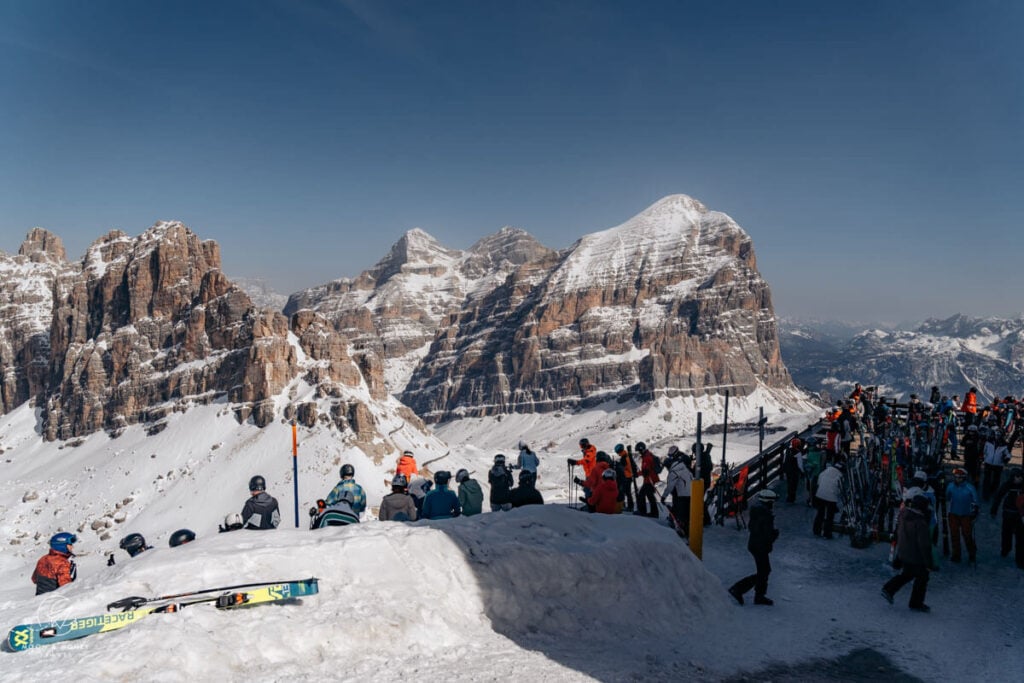
At the end of the slope, ride the famous horse-drawn tow (for an additional fee) to Hotel Armentarola, from where taxis (also extra) can bring you back to Passo Falzarego.
Parking | There’s a car park at Bai de Dones, where the Cortina Skyline and Cinque Torri lifts converge: Google Maps. That’s the best place to park. Further up the SR48 road, in the direction of Passo Falzarego, there’s another car park at Col Gallina: Google Maps. And, of course, there’s a car park at the Lagazuoi cable car valley station at Passo Falzarego.
Misurina Ski Area

The Misurina Ski Area is served by a single two-person chairlift, Col de Varda, which takes about 10 minutes. The Col de Varda slopes stay excellent well into the afternoon, thanks to the light crowds and orientation.
While it’s not worth a special trip, if you’re passing through, it’s a pleasant spot to enjoy an hour of crowd-free skiing away.
Hotels at Lake Misurina | Chalet Alpenrose (4-star hotel)
Where to Stay in Cortina d’Ampezzo for Skiing


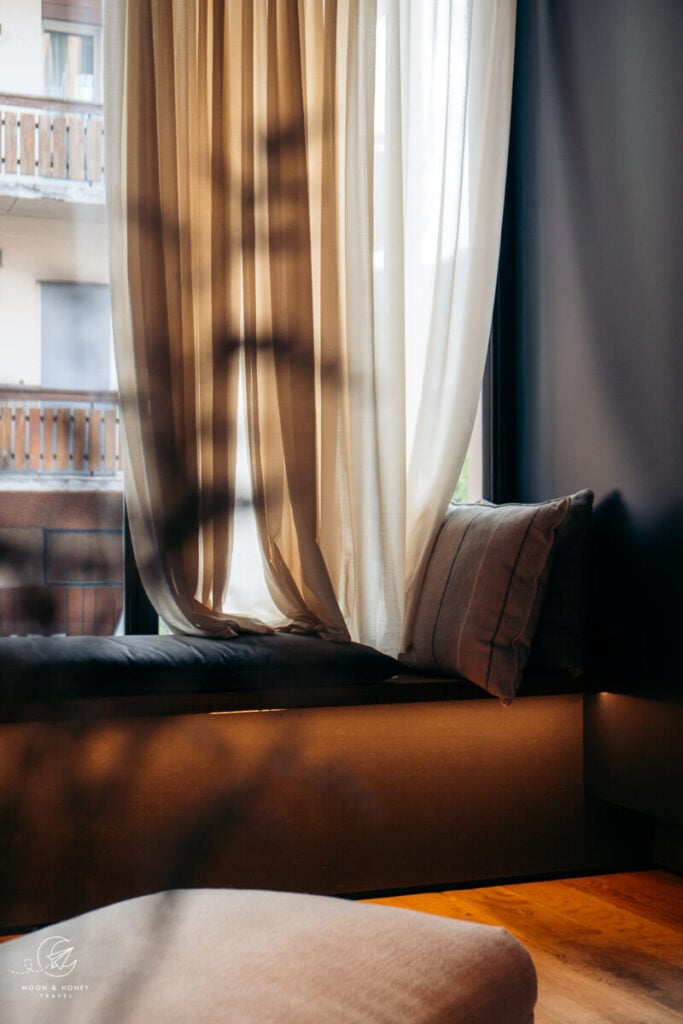
If you’re traveling without a car, I recommend staying in the town center or in an accommodation with a complimentary ski shuttle.
If you’re traveling with a car, you can look beyond the town center for accommodation options. For the most budget-friendly stays, check out B&B Hotel Passo Tre Croci Cortina at Passo Tre Croci, or Fiori Dolomites Experience Hotel, Hotel il Cardo, or Albergo Antelao in the town of San Vito di Cadore, 12 km south of Cortina d’Ampezzo.
We’ve stayed in B&B Hotel Passo Tre Croci Cortina (budget), Fiori Dolomites Experience Hotel (midrange), HOTEL de LËN (4-star hotel with ski shuttle. Read our Hotel de Len review), and Camina Suite & Spa (4-star hotel with ski shuttle. Read our Camina Suite & Spa Review).
| Village | Accommodation | Overview |
| Cortina d’Ampezzo Town Center | Hotel Ciasa Lorenzi (3-star hotel), Hotel Villa Alpina (3-star hotel), HOTEL de LËN (4-star hotel with ski shuttle), Ambra Cortina Luxury&Fashion Hotel (4-star hotel), Ancora Cortina (5-star hotel with ski shuttle), Grand Hotel Ampezzo (5-star hotel), Grand Hotel Savoia Cortina d’Ampezzo (5-star hotel) | Best atmosphere, walking distance to shops, restaurants, bars. Best option for traveling without a car. |
| Cortina d’Ampezzo North | Jägerhaus Agriturismo (farm stay), Hotel Des Alpes (3-star hotel), Hotel Menardi(3-star hotel), Dolomiti Lodge Alverà (4-star hotel), Camina Suite & Spa (4-star hotel with ski shuttle), Casa Guargnè (4-star hotel) | Close to the Freccia nel Cielo (Tofana) valley station. Accommodations with easy on-site parking. Car recommended. |
| Cortina d’Ampezzo South | Hotel Lajadira & Spa (4-star hotel), Faloria Mountain Spa Resort (5-star hotel), Rosapetra Spa Resort (5-star hotel) | Luxury accommodations with complimentary ski shuttles |
| Passo Tre Croci / Misurina | B&B Hotel Passo Tre Croci Cortina (Passo Tre Croci) and Chalet Alpenrose (4-star hotel in Misurina) | Budget-friendly accommodation. Car recommended. Short drive to Faloria-Cristallo & Misurina ski areas. Longer drive to Tofane ski area. |
| San Vito di Cadore | Fiori Dolomites Experience Hotel (3-star hotel), Hotel il Cardo (3-star hotel), Albergo Antelao (guesthouse), Hotel Albergo Dolomiti aka Dolomiti Sport Hotel (3-star hotel) | 12 km south of Cortina d’Ampezzo. Car recommended. Budget-friendly accommodation. Access to the small San Vito ski area (10 km of slopes). |
| Pocol and Vervei | Hotel Tofana Cortina (5-star hotel) and Ciasa Vervei (3-star hotel) | Hamlets above Cortina d’Ampezzo. Ski-in ski-out access to Tofane Ski Area, which is linked to Cinque Torri |
Learn more: Where to Stay in Cortina d’Ampezzo
Cortina d’Ampezzo Ski Season

The best times to ski in Cortina d’Ampezzo are January and March. We visited in mid-March and found excellent conditions overall. Faloria was nearly empty, while Tofana was busier but still manageable, with minimal lift wait times.
Snow quality on Faloria held up beautifully throughout the day, whereas Tofana was at its best in the morning.
While early December is often a great time to ski elsewhere in the Dolomites, it’s less reliable in Cortina due to staggered lift openings across the resort. Faloria may be skiable from early to mid-December, but much of Tofana typically doesn’t open until later in the month.
Similarly, the Falzarego-Cinque Torri area opens gradually from early December, with the Skyline Cortina gondola (linking Tofana and Cinque Torri) usually not operating until late December.
Outlying areas such as Auronzo and San Vito di Cadore have even shorter and more limited seasons, typically running from late December to mid-March, and are rarely worth a special trip for most skiers.
Check Cortina lift opening dates.
Cortina d’Ampezzo Ski Pass

To ski in Cortina d’Ampezzo, you only need to purchase a Cortina d’Ampezzo single resort pass. The only reason to purchase a Dolomiti Superski pass is if you plan on skiing the World War I ski tour (Grade Guerra), or if you want to ski in neighboring Alta Badia Ski Resort.
If you plan to ski the Hidden Valley Run but don’t intend to ski in Alta Badia, you won’t need a Dolomiti Superski pass, as the return to Passo Falzarego is by taxi.
Dolomites Winter Travel & Skiing
Skiing:
- Skiing in the Dolomites
- Ski-in Ski-out Hotels in the Dolomites
- Sella Ronda Ski Circuit
- Val Gardena Ski Resort
- Alta Badia Ski Resort
- Kronplatz Ski Resort
- 3 Zinnen Dolomites Ski Resort
- Carezza Ski Resort
- Latemar Dolomites Ski Resort
- Arabba Marmolada Ski Resort
- Val di Fassa Ski Resort
Winter Travel:
Dolomites Travel:
- Dolomites Travel Guide
- Places to Visit in the Dolomites
- Things to Do in the Dolomites
- How to Visit the Dolomites Without a Car
- Best Time to Visit the Dolomites
- Day Hikes in the Dolomites


Pin this Image for Future Trip Planning!
Stay Connected:
Connect with us on Pinterest.
Follow us on Instagram.
Like us on Facebook.
Support Us:
If you love reading my content, you can send me a direct donation.