The Italian Dolomites caters to all types of travelers and travel styles: honeymooners, families with small children, cyclists, multi-day trekkers, and day hikers.
We’ve stayed in farms, apartments, wellness hotels, and mountain huts. Each type of accommodation has its own benefits and limitations, which I’ll explain below.
If you’re trying to figure out which villages and towns to stay in, read Where to Stay in the Dolomites.
If you’re interested in staying in boutique and luxury hotels, read Best Hotels in the Dolomites.
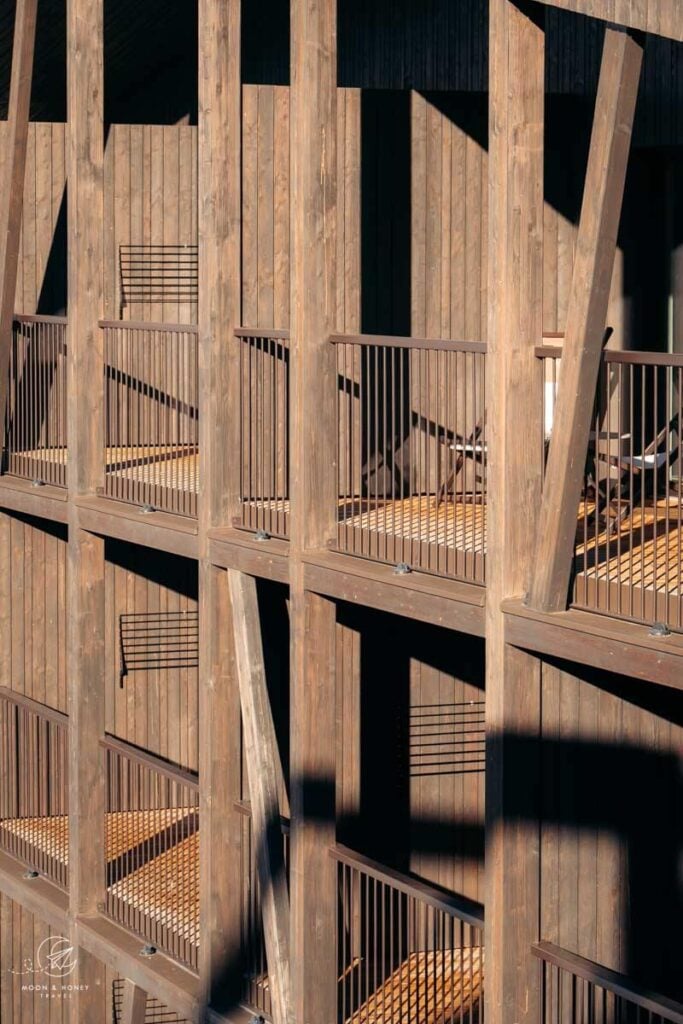
- Many accommodations in the Dolomites require a minimum stay of three or four nights. During high season, some hotels may increase the minimum stay requirement to 5 or even 7 days.
- The Dolomites stretch across 5 provinces in northeastern Italy: South Tyrol (Südtirol/Alto Adige), Trentino, Belluno, Udine and Pordenone. The best Dolomites accommodations are concentrated in the province of South Tyrol. Here, you’ll find the finest wellness and spa hotels.
- Book as early as possible. People plan annual trips to the Dolomites, booking a year ahead.
- Many hotels offer half board, where breakfast and dinner are included in the rate. If you’re traveling in shoulder-season/off-season, we highly recommend choosing a hotel with an on-site restaurant, or half-board offering.
- If you want maximum flexibility, we recommend staying in an apartment, or an aparthotel, with a fully-equipped kitchen.
- You can only camp in official campgrounds in the Dolomites. Wild camping is strictly prohibited.
- The most budget-friendly accommodations are farm stays and Pensionen (guesthouses).
- There is a high standard of hygiene in the Dolomites. So no matter the price point, you can expect clean accommodations.
Dolomites Accommodation Map
How to use this map | Click on each accommodation icon to display further information. Each color signifies a different Dolomites destination.
Dolomites Rifugios
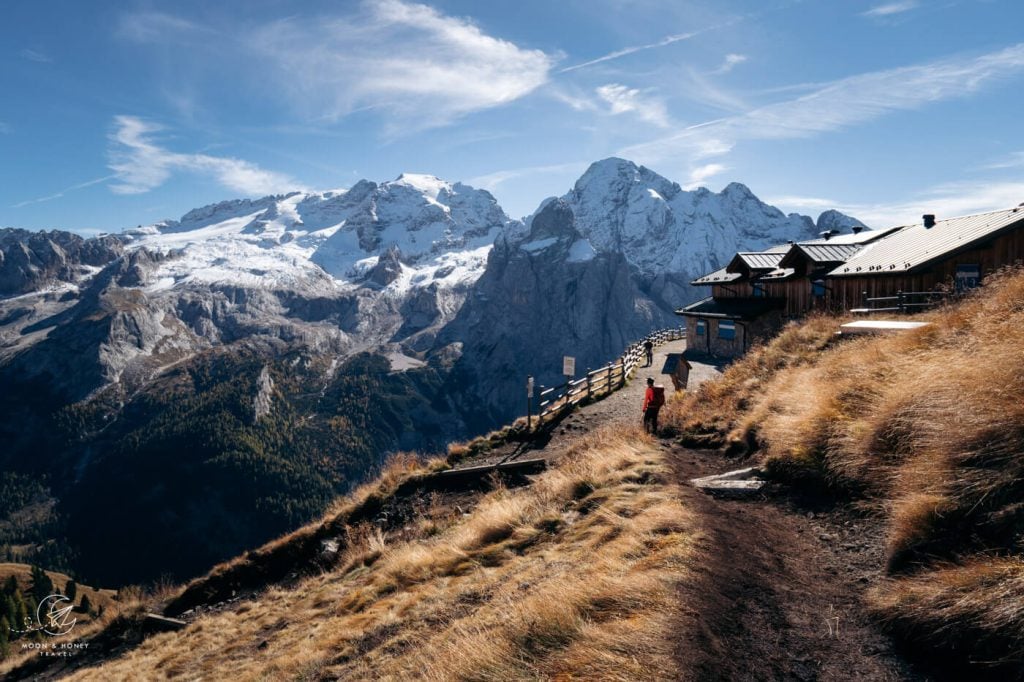
A Rifugio is a high-elevation mountain hut, situated directly on a hiking trail. These mountain refuges are staffed and offer hikers a warm place to sleep as well as food and drinks.
Most Rifugi are only accessible by foot, though there are exceptions (e.g. Rifugio Auronzo). Many huts are easy to reach, due to nearby cableway connections. For example, it’s a 20 minute walk from the Col Raiser Gondola mountain station to Rifugio Firenze.
Note: the plural of Rifugio in Italian is Rifugi, but English speakers commonly say Rifugios. In German-speaking South Tyrol, a Rifugio is called a Hütte.
There is a vast network of mountain huts across the Dolomites, making multi-day hiking extremely accessible. You can spend your whole trip in the Dolomites hiking from one hut to another.
These mountain huts range from very rustic, offering only the most basic amenities, to semi-luxurious. It’s important to realize that these Rifugios are first and foremost refuges for hikers, climbers and mountaineers.
They are not “mountain hotels.” Bathroom facilities are always shared, showers aren’t always available, and rooms are typically dormitory-style.
Upscale Rifugios in the Dolomites
If you’re someone who is looking for the experience of staying in a high-elevation refuge, but who also craves the comforts of a hotel (e.g. ensuite bathroom, private bedrooms), we recommend these upscale Rifugios:
Ütia de Börz is located at Passo delle Erbe, accessible by car from Alta Badia and Val di Funes. This excellent refuge facing Sass de Putia has private rooms with ensuite bathrooms. Their half board dinner menu is outstanding. We stayed here before/after hiking the Sass de Putia circuit trail.
Hut to Hut Routes
You can follow an established route like the famous Alta Vie (High Routes), or if you’re an experienced trekker, create your own route. We’ve done both.
If you’re new to hut to hut hiking, we highly recommend sticking to an established route and following a day by day itinerary in a guidebook:
Trekking in the Dolomites: Alta Via 1 And Alta Via 2 With Alta Via Routes 3-6 In Outline
Walking in the Dolomites: 25 Multi-day Routes in Italy’s Dolomites
Read Next: Hut to Hut Hiking in the Dolomites
When to Stay in a Dolomites Mountain Hut

Rifugios are typically open from late June until late September. Some huts will stay open in October, but only very few. We wrote about which huts stay open in Fall in Hiking in the Dolomites in October.
Some huts are also open in winter and host ski mountaineers.
When to Book Rifugios
It’s important to make reservations for mountain huts in the Dolomites at least 3-5 months in advance. For popular routes, we recommend booking 5 months in advance.
How to Book Rifugios

There is no uniform system for booking Rifugios. To find out how to book a specific Rifugio, simply Google the name of the Rifugio and click on the hut’s website. From here, you can quickly find out how to make a reservation.
Some huts will ask you to submit a reservation request form online. Other rifugio websites aren’t very sophisticated and only have a few contact details.
In cases like these, I’d first email the hut first. If you don’t get a response in a few days, you can follow-up with a call. We use Skype credits (pay as you go), to make international phone calls.
Important: some Rifugios along popular trails require deposits to secure your reservation.
You can also book a self-guided hiking tour with a trustworthy company like Alpenventures UNGUIDED.
They take care of all the logistics and you get to hike independently. We recommend this Best of the Dolomites Trek 9-day Standard self-guided tour, which runs west to east from Seceda to Tre Cime di Lavaredo. You can also book the AV1-10 Alta Via 1 Self Guided (10 stages), AV1-7 Alta Via 1 Self Guided (7 stages), or AV1-4 Alta Via 4 Self Guided (4 stages).
Alpine Club Member Discounts
Generally, Rifugi in the Dolomites are either owned by the Italian Alpine Club (Club Alpino Italiano – CAI) or the South Tyrol Alpine Club (Alpenverein Südtirol – AVS).
CAI or AVS-owned huts will administer a discount to members of UIAA alpine clubs that participate in the International Reciprocal Agreement on Mountain Huts (e.g. DAV, ÖAV, SAC, CAF). If you want to learn more about joining a UIAA alpine club, read Tips for Hiking in the Alps.
However, many huts are also privately owned and managed. These huts will not give alpine club members discounts on overnight stays.
Rifugio Essentials
Sleeping Bag Liner like this lightweight silk liner or this Cocoon Cotton liner
Waterproof House Slippers. We always bring our Crocs to wear in the huts. Crocs are great because they’re waterproof (perfect for showering), lightweight, and suitable for sock-wearing (unlike flip flops). Note: many huts provide slippers, but do you really want to wear communal slippers?
Reusable Water Bottles. You can fill up your water in most huts for free. If the tap water isn’t drinkable in the hut, there will be a sign. We both carry two 1-Liter water bottles each.
E-reader. There’s always ample time to read before dinner, or before bed. We always download a few books on our Kindle before a hiking trip.
Learn More: Hut to Hut Hiking Packing List
Farm Stays
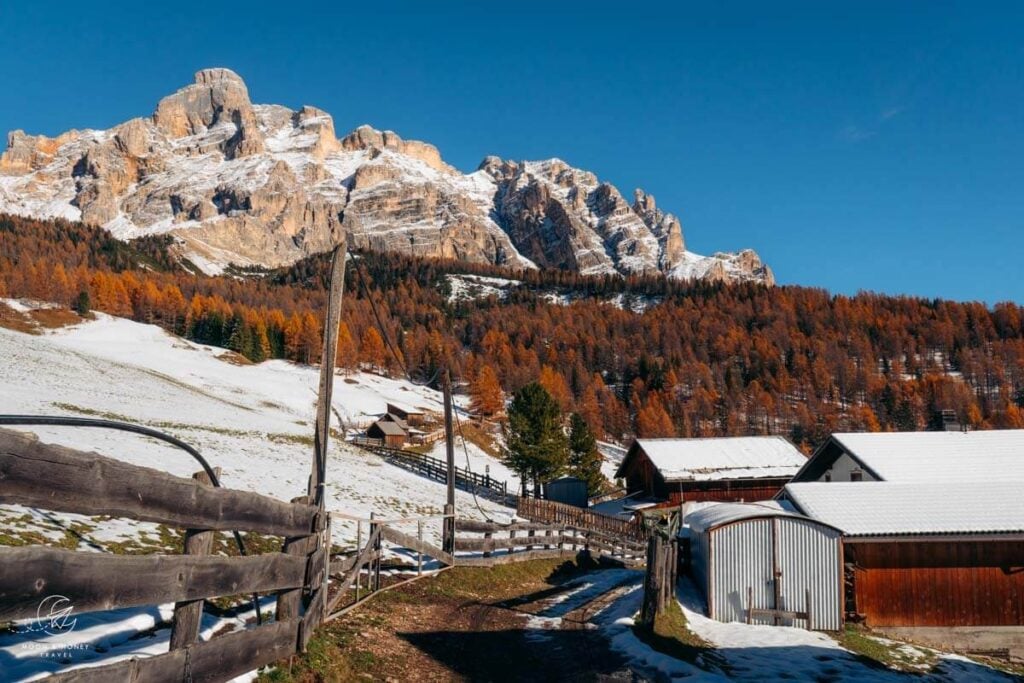
A farm stay (Agriturismo / Urlaub am Bauernhof) is a fantastic option for families as well as travelers on a budget. Farms are super down-to-earth accommodations, perfect for anyone who wants to be close to nature and farm animals.
We stayed in several Roter Hahn Farm Stays during our first trip to the Dolomites. The hosts were hospitable, the rooms were clean, and the prices were very economical. Roter Hahn (Red Rooster) is a trademark given to farmhouses in South Tyrol that provide quality holiday accommodations. There are 1,600 Roter Hahn farms across the province.
The goal of Roter Hahn is to put people in touch with the rural world of South Tyrol. Another objective is to help farmers establish another occupation and stream of income. Depending on the farm, you can opt for overnight stay only, bed and breakfast, or half board (breakfast and dinner).
Here are some farm stays you can book easily: Proihof in Val di Funes, Untertalhof in Castelrotto , Agriturismo Maso Runch in Badia, Agriturismo Feur Hof in San Martino in Badia, Lüch dl Kessl in San Martino in Badia, and Agriturismo Anví in Badia.
Apartments
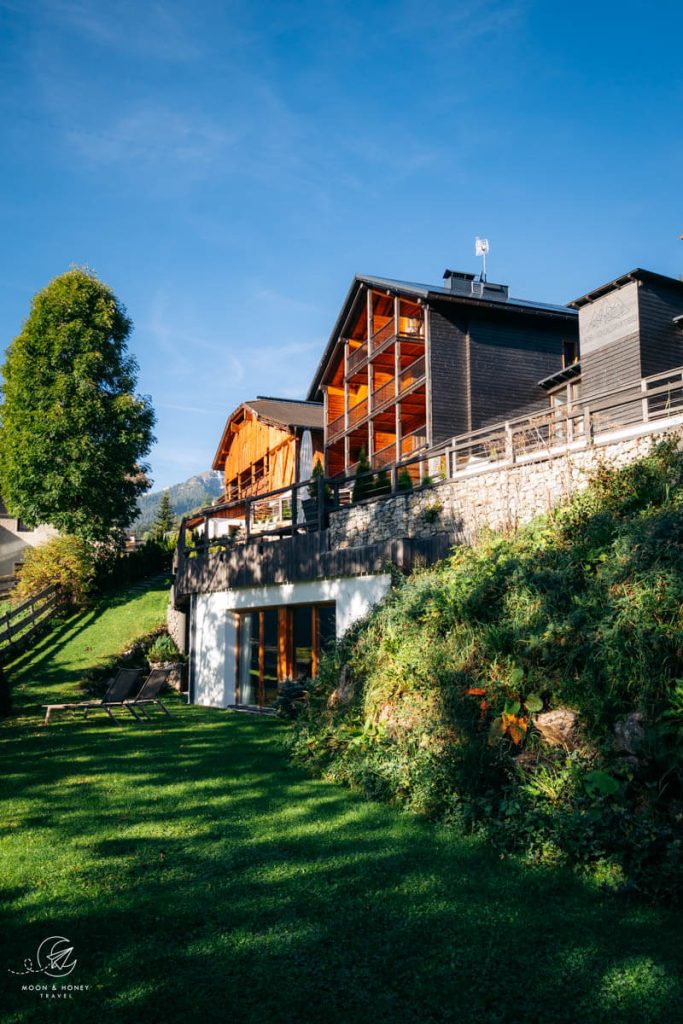
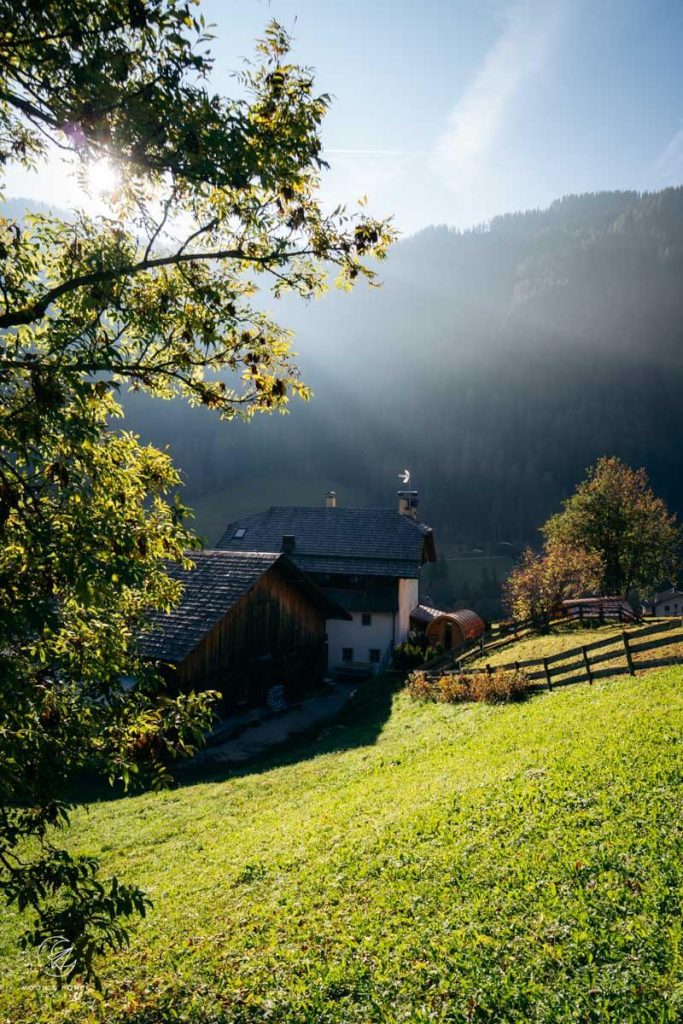
The Dolomites have two primary seasons: winter and summer. Many hotels, restaurants, and shops are closed in fall (November) and spring (April / May).
Self-catering accommodation is the best option for anyone traveling to the Dolomites off-season, or during shoulder season. If you’re visiting in late autumn, when most mountain huts and alpine pasture huts will be closed, an apartment is the most convenient option in terms of preparing your own packed lunches.
Ultimately, apartments give you the most flexibility. You don’t have to schedule your day around strict dinner and breakfast times. You can start your day as early as you want.
For anyone photographing sunrises and sunsets, an apartment is your best Dolomites accommodation option. We stayed in an apartment in San Martino di Castrozza, so that we could start hiking as early as possible, to avoid the crowds.
Aparthotels
There are also many aparthotels in the Dolomites. In these accommodations, you get the benefits of an apartment (e.g. kitchen) with the amenities of a hotel (e.g. wellness and spa facilities, on-site restaurant).
Many aparthotels offer breakfast, and sometimes even dinner.
We really enjoyed staying in Les Dolomites Mountain Lodges, an aparthotel in secret Lungiarü. Here’s our Les Dolomites Mountain Lodges review.
We also stayed in Lüch de Costa, a historical Ladin farmstead in Colfosco, Alta Badia, that was converted into several high-end apartments equipped with premium Miele kitchen appliances. The wellness area features an indoor pool, outdoor whirlpool, steam sauna, bio sauna, Finnish sauna, and waterbeds.
Alpine Pasture Huts

Across the Alps, livestock, including cows, goats, and sheep, are seasonally moved to high-elevation mountain pastures during the summer and returned to their stables in winter.
Traditionally, herdsmen stay in alpine pasture huts in summer in order to take care of their livestock.
While traditional alpine farming (“alpine transhumance”) is no longer as prevalent as it once was, there are still many active alpine pastures across the Dolomites. And, there are MANY alpine pasture huts.
Today, many of these huts are managed and function as rustic mountain restaurants, serving food and drinks to hikers and cyclists during the day. Some of these huts still produce their own cheese and dairy.
Unlike a Rifugio (mountain shelter), alpine pasture huts (Malga, Baita, Alm, Almhütte, Schwaige) usually don’t offer overnight lodging.
But, there are a smattering of mountain pasture huts that accommodate overnight guests, if you know where to look.
Plafötschalm (Plafetsch Alm) is a family-run mountain pasture hut situated at an elevation of 1570 meters in Tiers am Rosengarten/Tires al Catinaccio, South Tyrol. More intimate and relaxed than a classic Rifugio, Plafötschalm is a great option for families with children, or anyone who wants to unwind in an idyllic alpine location.
- Arrival: You can get a pick-up from the road (46.468514, 11.578427), if you call in advance. Otherwise, you can walk up from the small parking area in 30-40 minutes.
- We recommend staying 1-2 nights. There aren’t a lot of (officially marked) hikes you can do directly from the hut, so it doesn’t make sense to stay longer.
Dolomites Campgrounds
In the Dolomites, camping is only allowed on official campgrounds. Wild camping is strictly prohibited.
There is a lot of misleading information online and on social media regarding wild camping in the Dolomites. We implore you to abide by the rules. If you want to stay overnight in the mountains, stay in the mountain huts.
We stayed in the guesthouse at Camping Sass Dlacia (1680 m), which is located at the entrance to Fanes-Sennes-Braies Nature Park in San Cassiano, Alta Badia. The highest elevation campground in the Dolomites boasts a wellness center, pizzeria, and shop. It’s located directly at the entrance to Fanes-Sennes-Braies Nature Park.
Here are the best campgrounds in the Dolomites:
- Caravan Park Sexten: campground and bungalows and treehouses
- Campsite Seiser Alm close to the Alpe di Siusi Plateau
- Camping Toblacher See at Lago di Dobbiaco
- Camping Catinaccio Rosengarten in Pozza di Fassa, Val di Fassa
- Steiner Camping Park near Bozen / Bolzano
- Camping Al Plan, San Vigilio di Marebbe, Val Badia, at the entrance of the Fanes-Senes-Braies Natural Park
Hotels

Hotels offer greater comfort and amenities than other types of accommodation. While sometimes we really like the flexibility of an apartment, most times we prefer the convenience of a hotel, especially when it comes to food.
Many hotels offer half board (breakfast and dinner) with unique daily menus. This is the most relaxing option. You don’t have to think about and plan where you’re going to eat every day.
Sometimes breakfast and dinner times are restrictive. But, for us, those times are consistent with when we would want to eat anyway. Very active hikers/climbers (e.g. who want to start hiking at 6 am) and photographers (e.g. who want to capture Enrosadira), may not want those time limitations.
There are many gourmet hotels in the Dolomites. From our personal experience, we can highly recommend Dorfhotel Beludei in Santa Cristina, Val Gardena, and Naturhotel Leitlhof in San Candido, Alta Pusteria.
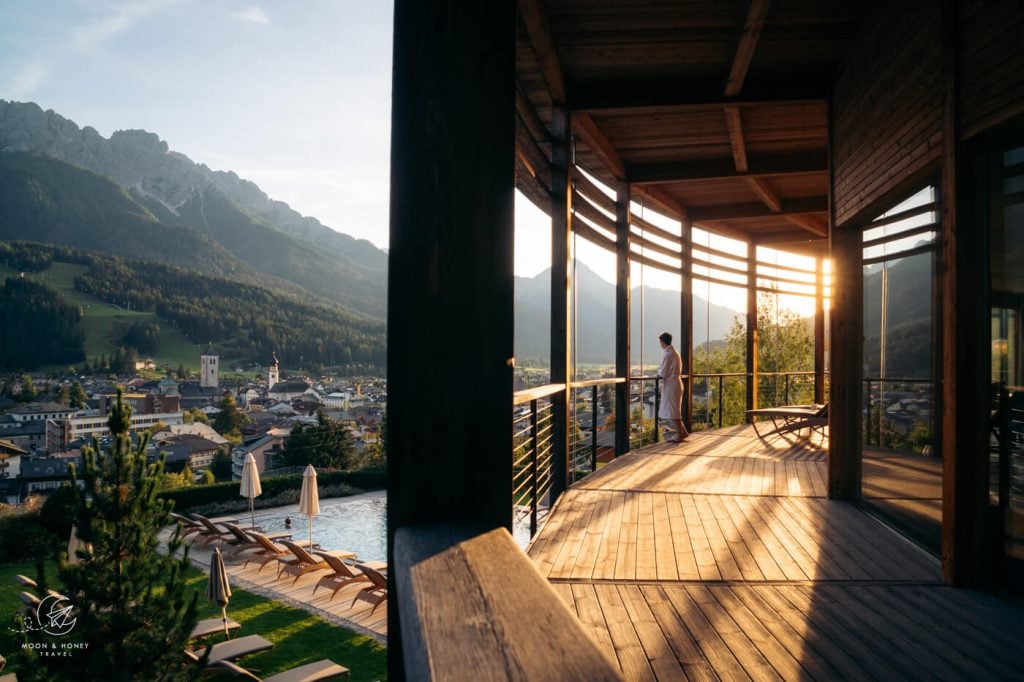
Many Dolomites hotels, at the very minimum, have a steam sauna, a Finnish sauna, and a relaxation room. Wellness hotels will often feature 4-5 different saunas, a hot tub, 1-2 pools, several relaxation rooms, and offer spa treatments.
Why on earth would someone want to spend time in a sauna when you’re in one of the most beautiful places on earth? The main reason is weather. In the Dolomites, like everywhere else in the European Alps, weather isn’t consistently good. There will always be a rainy day, or a few.
If you come to the Dolomites and you experience several days of rain (we certainly have), you’ll feel kinda devastated. But, if you stay in a wellness hotel, those rainy days become rejuvenating spa days.
In winter, it’s part of the skiing culture to head to the sauna after a day on the slopes. In summer, it’s equally enjoyable. If you’ve been hiking all day, your body will feel restored after a few sauna sessions.
Sauna Etiquette

In the Dolomites, you’ll experience a clash of cultures in the sauna areas. In South Tyrol, abide by Austrian and German sauna etiquette. Do not wear a bathing suit into the sauna. In dry saunas, make sure your body doesn’t touch the wood. Always place a towel beneath you. This is the most hygienic way “to sauna.”
In the other provinces, where Italian culture is more dominant (they don’t like being naked), you’ll find a mix of people wearing/not wearing bathing suits. Just follow the rules of each hotel.
Our Dolomites Hotel Guides:
- Best Val Gardena Hotels
- Best Alta Badia Hotels
- Dorfhotel Beludei in Santa Cristina, Val Gardena
- AMA Stay in San Vigilio
- Excelsior Dolomites Life Resort in San Vigilio
- Locanda degli Artisti Art Hotel in Canazei, Val di Fassa
- Camina Suite & Spa in Cortina d’Ampezzo
- Hotel de Len in Cortina d’Ampezzo
- Naturhotel Leitlhof in San Candido
- Alpenwellness Hotel St. Veit in Sexten, Alta Pusteria
- Badia Hill in Badia, Alta Badia
- Posta Zirm Hotel in Corvara, Alta Badia
- My Arbor near Brixen
Pin this Image for Future Trip Planning!
Stay Connected:
Connect with us on Pinterest.
Follow us on Instagram.
Like us on Facebook.
Support Us:
If you love reading our content, you can buy us a coffee via Ko-Fi.